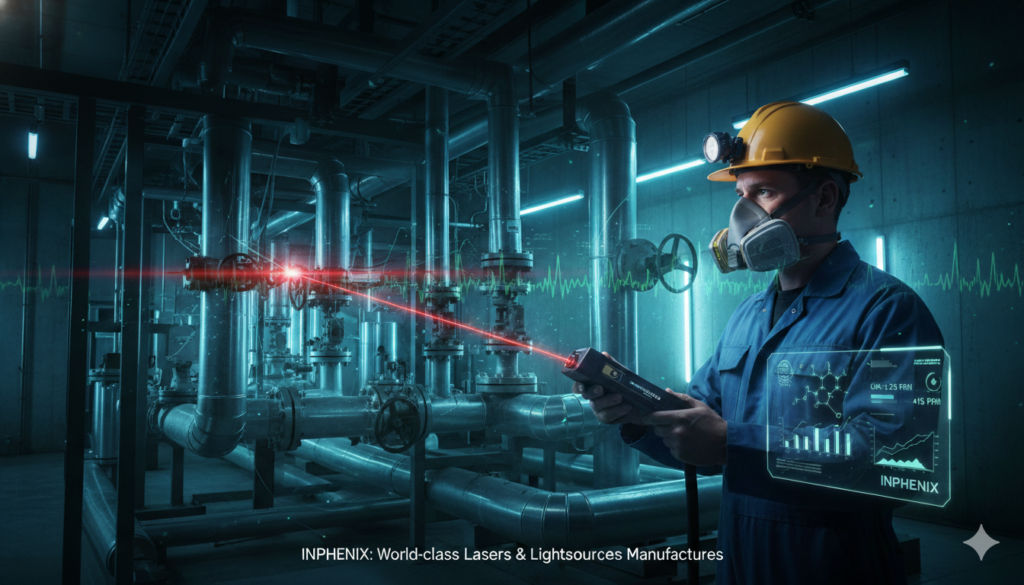
In an era increasingly defined by climate change, air quality concerns, and industrial safety regulations, the need for highly accurate, reliable, and real-time lidar-enhanced gas sensing solutions has never been more critical.
From detecting greenhouse gas emissions to monitoring hazardous industrial leaks, the precision and stability of optical sensing technologies, including advancements in optics, are paramount. Among these, DFB lasers (Distributed Feedback Lasers) have emerged as a cornerstone, offering unparalleled performance that is revolutionizing environmental monitoring and industrial process control.
At INPHENIX, a world-class manufacturer of lasers and light sources, we stand at the forefront of this revolution. We provide leading-edge, high-quality DFB laser solutions specifically engineered for demanding gas sensing and environmental monitoring applications. Our commitment to innovation, including advanced laser cutting techniques, ensures that our DFB laser products empower the next generation of sensing instruments.
The Critical Need for Advanced Gas Sensing
Traditional gas sensing methods often suffer from limitations such as cross-sensitivity to other gases, slow response times, limited accuracy, and requirements for frequent calibration.
As the complexity of environmental challenges grows, so does the demand for advanced equipment and spectroscopic techniques that, alongside laser cutting technologies, can overcome these hurdles. The unique properties of DFB lasers make them exceptionally well-suited to meet this demand.
The applications are diverse and critical, including:
- Climate Change Monitoring: Accurate measurement of greenhouse gases like CO2, methane (CH4), and nitrous oxide (N2O).
- Industrial Safety: Detection of explosive gases, toxic industrial chemicals (TICs), and volatile organic compounds (VOCs).
- Air Quality Monitoring: Real-time assessment of pollutants in urban and industrial areas.
- Process Control: Monitoring gas compositions in manufacturing processes.
- Medical Diagnostics: Breath analysis for non-invasive detection of certain biomarkers.
Understanding DFB Lasers: The Heart of Precision Sensing
A DFB laser is a type of semiconductor laser diode that incorporates a periodic diffraction grating structure within its active region. This design forces the laser to oscillate at a single, very precise wavelength.
This fundamental feature gives DFB lasers distinct advantages for spectroscopy:
- Single-Mode Operation: Emits light at a single, narrow spectral line, essential for targeting specific absorption lines of gases.
- Narrow Linewidth: Allows for highly resolved spectroscopic measurements.
- Wavelength Stability: Remarkably stable output wavelength, critical for consistent monitoring.
- Tunability: The output wavelength can be precisely tuned, enabling quantitative measurement.
- Compactness and Robustness: Small, solid-state devices suitable for integration into portable instruments.
Tunable Diode Laser Absorption Spectroscopy (TDLAS): The Power of DFB Lasers
The primary technique leveraging the strengths of DFB lasers is Tunable Diode Laser Absorption Spectroscopy (TDLAS).
Here’s how it works:
- Precise Wavelength Selection: A DFB laser is selected to emit light matching a unique absorption fingerprint of the target gas molecule.
- Wavelength Scanning: The laser’s wavelength is scanned across this absorption line.
- Absorption Measurement: A detector measures the intensity of the transmitted light as the target gas absorbs specific wavelengths.
- Concentration Calculation: The gas concentration is determined by analyzing the absorption feature’s shape and depth.
TDLAS offers significant advantages in optics, including:
- High Selectivity: Narrow linewidth ensures detection of specific absorption lines, eliminating interference.
- High Sensitivity: Capable of detecting gases at very low concentrations.
- Fast Response Time: Rapid measurements enable real-time monitoring.
- Non-Contact Measurement: Lidar technology simplifies system design and reduces equipment maintenance.
- Long-Term Stability: Minimizes drift and recalibration needs, reducing costs.
Key Applications of DFB Lasers in Environmental Monitoring
The impact of DFB lasers on environmental monitoring is extensive and growing.
- Greenhouse Gas Monitoring: Networks of TDLAS sensors using DFB lasers and diffraction grating systems are deployed globally, providing crucial data for climate models.
- Industrial Emissions Control: Used in industries like power generation and petrochemicals to monitor smokestack emissions.
- Air Quality Networks: Contributing to real-time air quality monitoring in urban areas.
- Leak Detection in Oil & Gas: Provides sensitive and rapid detection of methane and other hydrocarbon leaks.
- Combustion Analysis: Optimizes combustion processes in engines and boilers for maximum efficiency.
DFB Lasers in Industrial Safety and Process Control
Beyond environmental concerns, DFB lasers are vital for operational safety and efficiency.
- Chemical Manufacturing: Ensures optimal yields and prevents buildup of hazardous byproducts.
- Semiconductor Fabrication: Detects trace contaminants affecting chip quality, often utilizing laser cutting technology for precise manufacturing.
- Food and Beverage Industry: Monitors gas headspace in packaging to extend shelf life.
- Medical Gas Analysis: Ensures the correct composition of medical gases.
The INPHENIX Advantage: Precision DFB Lasers for Tomorrow’s Challenges
As a leading manufacturer, INPHENIX understands that the performance of a TDLAS system is linked to the DFB laser source’s quality and stability.
We offer:
- Ultra-Narrow Linewidth: For challenging trace gas detection.
- Exceptional Wavelength Stability: Ensures consistent, accurate measurements.
- Precise Wavelength Control: Fine-tuning capabilities across specific absorption bands.
- High Output Power: Needed for long optical path lengths, enhancing the optics of the system.
- Robust and Compact Packaging: Designed for reliable operation in demanding environments.
- Broad Wavelength Coverage: Operating at wavelengths crucial for various gases.
We work closely with developers and integrators to provide custom solutions, ensuring reliability and longevity.
The Future of DFB Lasers in Sensing
The field of gas sensing is continuously evolving.
Future trends include incorporating advanced technologies such as lidar:
- Further Miniaturization: Developing even smaller, lower-power DFB lasers.
- Increased Integration: Combining lasers with other photonic components on a single chip.
- Multi-Gas Sensing: Detecting multiple gases simultaneously with the use of diffraction grating technology.
- Quantum Cascade Lasers (QCLs): Extending sensing for new gas species.
Conclusion
DFB lasers are indispensable components for precise, stable, and real-time gas sensing.
Their unique properties make them ideal for applications in environmental monitoring, industrial safety, laser cutting, and process control.
As the challenges of global climate change and industrial safety continue to grow, the demand for advanced sensing technologies will only intensify.
INPHENIX is proud to be a leading partner, pushing the boundaries of DFB laser technology to equip the world with tools for a safer, cleaner, and more efficient future.
Our dedication to quality and performance ensures that our DFB laser solutions drive innovation worldwide.
As the challenges of global climate change and industrial safety continue to grow, the demand for advanced sensing technologies will only intensify. INPHENIX is proud to be a leading partner in this endeavor, continually pushing the boundaries of DFB lasertechnology to equip the world with the tools needed for a safer, cleaner, and more efficient future. Our dedication to quality and performance ensures that our DFB lasersolutions remain at the cutting edge, driving innovation in gas sensing and environmental protection worldwide.