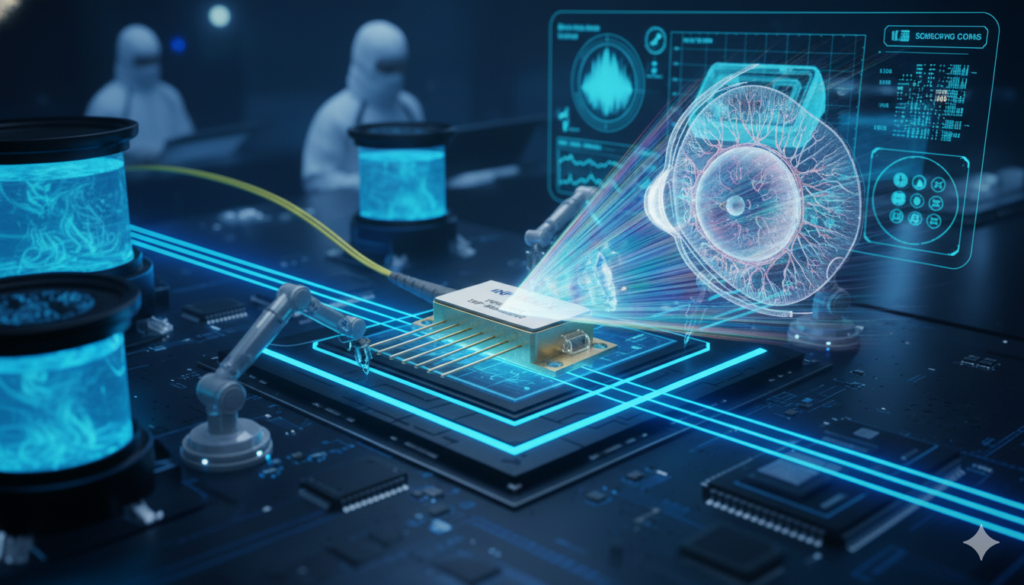
In the demanding world of modern medicine, the accuracy, speed, and safety of diagnostic and therapeutic procedures often hinge on the quality of the light source employed. From intricate surgical guidance to high-resolution imaging, a reliable and precisely characterized light source is not merely a component but a critical enabler of advanced healthcare.
For medical professionals and device manufacturers seeking optimal performance, the choice of light source is paramount. Among the array of available technologies, Superluminescent Diodes (SLDs) have emerged as a superior choice, consistently excelling in diverse clinical settings.
This comprehensive guide, presented by Inphenix World-class Lasers & Lightsources Manufacturers, delves into the critical factors for selecting a medical light source and illuminates why SLDs stand out as the preferred option.
The Foundation of Medical Innovation: Understanding the Medical Light Source Landscape
The landscape of medical light source technologies is vast, each with its unique strengths and limitations in terms of illumination quality. Traditional options include halogen lamps, xenon arc lamps, and LEDs, while more advanced solutions encompass laser diodes and, critically, Superluminescent Diodes (SLDs).
Each light source type offers different characteristics in terms of spectral output, power, coherence, lifetime, and form factor, all of which directly impact its suitability for specific medical applications.
- Halogen/Xenon Lamps: Broad spectrum, but low power efficiency, short lifespan, significant heat generation, and large form factor.
- LEDs: Compact, energy-efficient, long lifespan, but limited spectral bandwidth and lower power compared to SLDs or lasers for certain applications.
- Laser Diodes: High power, narrow spectral bandwidth, high coherence, but prone to speckle artifacts in imaging and can pose safety concerns without careful management due to high coherence.
- Superluminescent Diodes (SLDs): Offer a unique sweet spot, combining broad spectral bandwidth (like LEDs) with high optical power and spatial coherence (like lasers), but crucially, with low temporal coherence.
Understanding these distinctions in luminosity and other factors is the first step in choosing the light source that will empower your medical device or procedure to achieve its full potential.
Key Considerations for Selecting a Medical Light Source
1. Performance and Spectral Characteristics
The optical properties and radiant glow of the light source directly dictate its suitability for specific medical applications.
Different biological tissues interact with light at various wavelengths. For example, Superluminescent Diodes (SLDs) operating around 840 nm and 105 nm are ideal for shallow tissue imaging, while 131 nm and 155 nm SLDs penetrate deeper into biological tissues.
A broad spectral bandwidth is paramount for applications like Optical Coherence Tomography (OCT), enabling clinicians to visualize incredibly fine details within tissue structures.
Sufficient optical power is essential for achieving adequate signal-to-noise ratios, especially when imaging deep tissues.
The low temporal coherence of SLDs minimizes speckle noise, invaluable for high-fidelity imaging and precise measurements.
2. Safety and Biocompatibility
Any medical light source must adhere to stringent safety standards. Wavelength, power, and beam divergence all factor into eye safety classifications. SLDs often present a more manageable safety profile due to their relatively lower coherence compared to lasers.
Efficient heat dissipation is crucial to prevent overheating and potential tissue damage, while germicidal properties can ensure a sterile operating environment.
The light source must comply with relevant medical device regulations, including specific requirements for optical emissions.
3. Reliability and Lifetime
In clinical settings, downtime is not an option. The long-term reliability of a light source is paramount.
A long mean time to failure (MTTF) reduces maintenance costs and ensures device availability. SLDs boast impressive lifetimes, often tens of thousands of hours.
The output power, luminosity, radiance, and spectral characteristics of the light source, including its illumination, glow, and germicidal effectiveness, must remain stable over time and across varying environmental conditions.
The light source and its packaging must withstand typical clinical use.
4. Form Factor and Integration
The physical attributes of the light source significantly influence device design and usability.
Compact light source solutions enable smaller, more portable medical devices, increasingly sought after for point-of-care diagnostics.
Energy-efficient light source options reduce operating costs.
Integration with fiber-optic systems is often essential for flexibility.
5. Cost-Effectiveness
While patient outcomes are paramount, the cost-effectiveness of the light source cannot be ignored.
Factors to consider include:
- Initial Purchase Price
- Operational Costs
- Maintenance and Replacement
High-reliability SLDs minimize these costs, proving to be a cost-effective light source in the long run.
Why Superluminescent Diodes (SLDs) Excel in Clinical Settings
Considering the factors above, Superluminescent Diodes (SLDs) consistently emerge as the superior light source for a vast array of medical applications.
- Unmatched Resolution in OCT: The broad bandwidth and low temporal coherence of SLDs are fundamental to achieving high axial resolution for detailed cross-sectional imaging.
- Reduced Speckle Noise: Unlike lasers, the low temporal coherence of SLDs significantly reduces speckle noise, leading to clearer, artifact-free images.
- High Power for Deep Penetration: SLDs provide sufficient optical power to penetrate biological tissues effectively, imparting a subtle glow that enhances visualization.
- Excellent Fiber Coupling: High spatial coherence ensures efficient coupling into single-mode fibers.
- Compact and Reliable: SLDs are compact and robust, boasting long operational lifetimes.
- Versatility Across Applications: From medical sensing to germicidal applications in fiber optic gyroscopes, SLDs serve as an exceptional light source.
In essence, SLDs offer the best of both worlds: the power and spatial coherence needed for effective light delivery, combined with the broad spectrum and low temporal coherence necessary for high-resolution imaging.
Inphenix: Your Trusted Partner for Medical SLD Light Sources
As a world-class manufacturer of lasers and light sources, Inphenix stands at the forefront of Superluminescent Diode technology.
We provide:
- Precision Engineering: Advanced epitaxy and fabrication processes.
- Rigorous Quality Control: Comprehensive testing and characterization.
- Customization Expertise: Tailored SLD solutions.
- Dedicated Support: Expert technical support and application guidance.
The Future of Medical Light Sources: SLDs Leading the Way
The trajectory of medical technology points towards less invasive, more precise tools. Superluminescent Diodes (SLDs) are perfectly positioned to meet these demands, ensuring your medical devices remain at the forefront of healthcare technology.
Conclusion: Making the Right Light Source Choice with Confidence
The decision of which medical light source to employ is critical.
For applications demanding high resolution, low noise, luminosity, and broad bandwidth, Superluminescent Diodes (SLDs) consistently demonstrate superior capabilities.
Empower your medical device with world-class SLD technology and enhance illumination in healthcare applications!
Don’t settle for anything less than optimal performance.
Contact Inphenix today for a no-obligation consultation and request a quote!
Illuminate the radiance of the future of healthcare with Inphenix SLDs – Where precision meets clinical excellence.