In the dynamic world of photonics, where precision and efficiency reign supreme, the Vertical-Cavity Surface-Emitting Laser, or VCSEL, stands out as a revolutionary technology. As a cornerstone of modern optical systems and an integral component in the field of optics, VCSELs have transformed everything from data communications to advanced sensing applications. For Inphenix, a world-class manufacturer of lasers and light sources, understanding the intricate workings of the VCSEL is not just about appreciating its brilliance, but also about pushing the boundaries of what’s possible.
This comprehensive guide will delve into the fundamental principles, design, and operational mechanisms that make the VCSEL an indispensable component in today’s high-tech landscape.
The Genesis of Light: Understanding Basic Laser Principles
Before we unravel the complexities of the VCSEL, it’s crucial to grasp the foundational concepts of laser operation.
A laser, an acronym for Light Amplification by Stimulated Emission of Radiation, produces a highly concentrated beam of coherent light.
This process fundamentally relies on three key elements:
- Gain Medium: A material (solid, liquid, or gas) capable of amplifying light. In VCSELs, this is typically a semiconductor material.
- Energy Source (Pumping Mechanism): An external source that excites atoms within the gain medium to a higher energy state. For VCSELs, this is usually electrical current.
- Optical Resonator (Cavity): A system of mirrors that reflects light back and forth through the gain medium, stimulating further emission and amplification.
The continuous cycle of stimulated emission and reflection within the optical resonator leads to the exponential amplification of photons, resulting in a coherent laser beam.
Decoding the VCSEL Architecture: A Vertical Approach to Light Emission
Unlike traditional edge-emitting lasers, which emit light from the side of a semiconductor chip, the VCSEL emits light perpendicularly from the surface. This vertical emission is a defining characteristic and a key differentiator, offering numerous advantages.
At its core, a VCSEL comprises several carefully engineered layers:
- Active Region (Quantum Wells): This is the heart of the VCSEL, where light generation occurs. It consists of multiple quantum wells, ultra-thin layers of semiconductor material (e.g., indium gallium arsenide, gallium arsenide) sandwiched between barrier layers. When an electrical current flows through these layers and a diode is involved, electrons and holes recombine within the quantum wells, releasing photons.
- Distributed Bragg Reflectors (DBRs): These are the mirrors of the VCSEL’s optical cavity and are crucial for the laser’s performance, determining its resonant wavelength and output power.
- Current Confinement Aperture: Ensures efficient operation by funneling current into the active region, leading to a smaller active area and laser spot size.
- Electrical Contacts: Metal contacts on the top and bottom of the VCSEL structure allow for the injection of electrical current, designed to minimize resistance.
VCSEL devices, like a diode, are fabricated using sophisticated semiconductor manufacturing processes, such as molecular beam epitaxy (MBE) or metalorganic chemical vapor deposition (MOCVD).
The Inner Workings: How a VCSEL Generates Light
Let’s trace the journey of light generation within a VCSEL:
- Electrical Pumping: A voltage applied across the VCSEL’s electrical contacts injects electrons and holes into their respective layers, drifting toward the active region.
- Carrier Recombination and Spontaneous Emission: In the quantum wells, electrons and holes recombine, releasing energy as photons in a random process called spontaneous emission.
- Optical Amplification via Stimulated Emission: Some photons travel through the optical cavity formed by the DBRs, prompting further stimulated emission and amplifying the light.
- Resonance and Lasing: The cavity’s resonance condition, met by matching the DBR distance with the photon wavelength, leads to a rapid build-up of photon density.
- Light Emission: The top DBR, being slightly less reflective, allows amplified, coherent light to escape from the VCSEL surface as a laser beam.
The control over DBR design enables VCSELs to emit light at specific wavelengths, such as 850 nm for short-reach data communication.
Key Advantages of VCSEL Technology
The unique architecture and operational principles of the VCSEL translate into a host of significant advantages in optics:
- Low Threshold Current: Reduced current requirement for lasing leads to lower power consumption.
- High Modulation Speed: Allows modulation at high frequencies, ideal for data transmission.
- Surface Emission and Wafer-Level Testing: Facilitates testing before dicing, reducing costs and increasing yield.
- Circular Beam Profile: Simplifies coupling to optical fibers due to low divergence.
- Temperature Stability: Reduces the need for extensive temperature control.
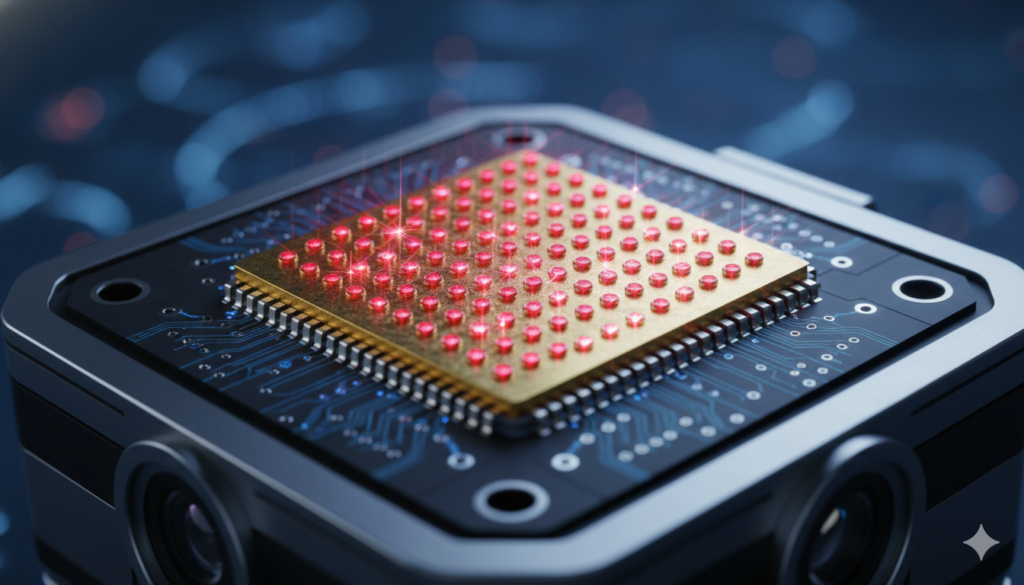
- Array Integration: Supports 2D arrays for applications like LiDAR and optical interconnects.
- Reliability: Robust design ensures long operational lifetimes.
Applications Revolutionized by VCSEL
The versatility and performance of VCSEL technology make it indispensable across a wide array of industries:
- Data Communications: Essential for short-reach optical interconnects in data centers.
- 3D Sensing and LiDAR: Powers applications in consumer electronics and automotive LiDAR.
- Optical Mice: Provides a reliable light source for tracking movement in mice, a fundamental component of optics technology.
- Printers and Scanners: Used in systems requiring precise light sources.
- Medical and Industrial Heating: Offers localized and efficient energy sources.
The Future of VCSEL Technology
Advancements in VCSEL technology continue:
- Higher Power VCSELs: For industrial material processing and high-power LiDAR.
- Longer Wavelength VCSELs: For extended-reach communication and specialized sensing.
- Tunable VCSELs: Useful in spectroscopy and advanced optical networking.
- Integrated Photonics: Enables compact, efficient optical systems.
- Advanced Modulation Schemes: Increase data throughput capabilities.
The VCSEL diode is a testament to the ingenuity of semiconductor physics and optical engineering. Its attributes and adaptability ensure it remains a critical technology in driving progress in the digital age.
Discover the Power of Precision with Inphenix VCSEL Solutions!
Ready to integrate world-class VCSEL technology into your next project? At Inphenix, we leverage decades of expertise to design and manufacture cutting-edge VCSELs that deliver unparalleled performance and reliability.
From high-speed data communications to advanced 3D sensing, our customized VCSEL solutions are engineered to meet your most demanding specifications.
Contact Inphenix today to discuss your specific requirements and unlock the full potential of VCSEL technology!