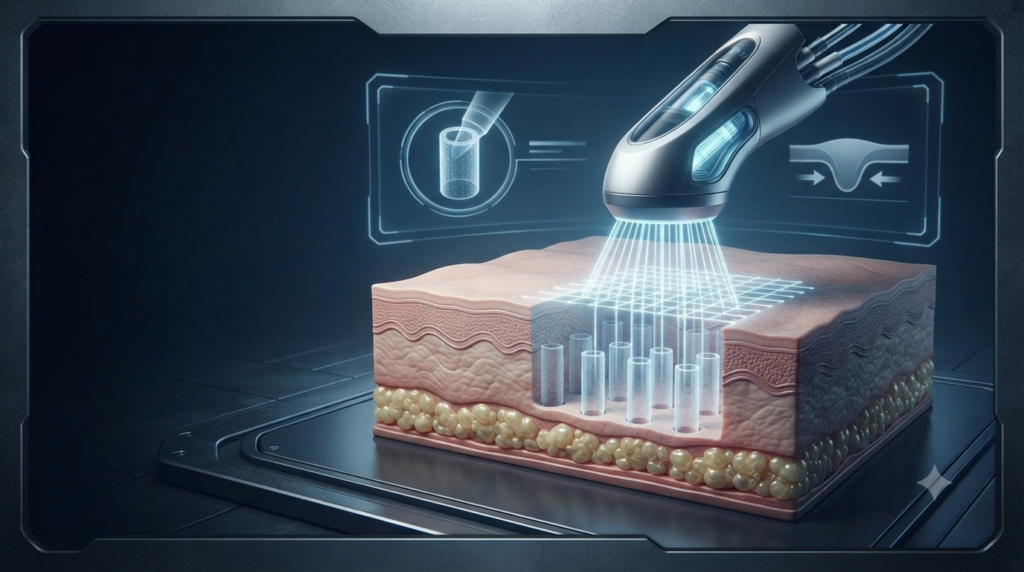
The continuous evolution of dermatological hardware and aesthetic engineering, including advancements in laser treatments like laser-coring, has redefined the parameters of skin rejuvenation.
For decades, traditional fractional resurfacing stood as the definitive industry benchmark for treating severe photoaging, deep scars, and skin laxity, until the innovation of laser-coring emerged. However, the emergence of laser coring has fundamentally shifted clinical paradigms.
By mechanically and optically removing microscopic columns of skin rather than relying strictly on thermal vaporization, this novel modality introduces unprecedented precision.
For aesthetic device manufacturers, clinicians, and medical spa directors, understanding the technical differences between these approaches is critical.
Integrating advanced component solutions—such as precision optics and reliable light sources inspired by Inphenix Customization & Foundry Service—allows developers to engineer the next generation of high-precision dermatological systems.
The Core Mechanics: How Laser Coring Works
To appreciate why laser coring is capturing massive search volume and clinical interest, one must examine its foundational physics.
Traditional fractional resurfacing utilizes ablative lasers (such as CO2 or Erbium:YAG) to create microscopic treatment zones (MTZs) through thermal destruction. Water molecules inside the tissue absorb the optical energy, vaporizing cells and leaving surrounding bridges of healthy tissue intact to accelerate healing.
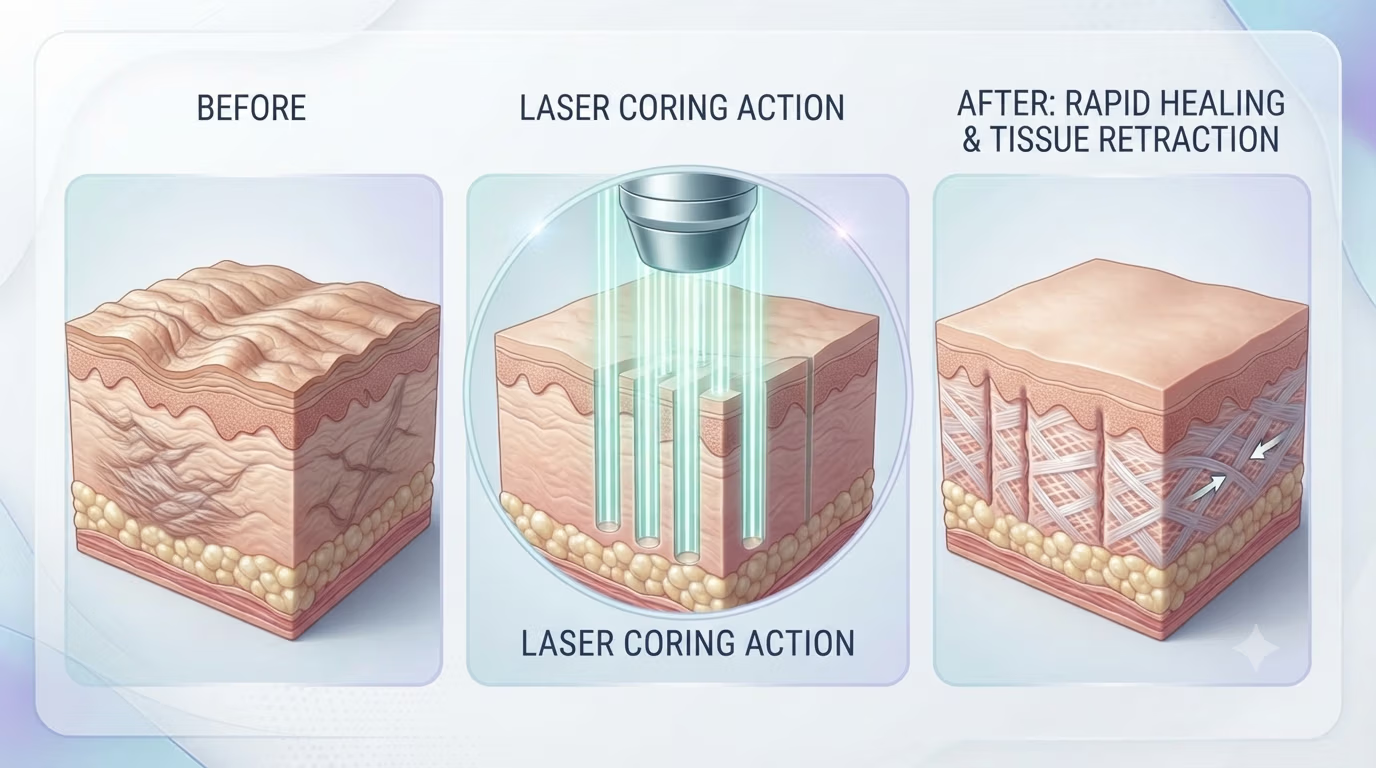
In contrast, laser coring utilizes ultra-fast, high-peak-power laser architectures, such as ultraclear technology, to physically excise microscopic micro-columns of skin tissue. Instead of relying purely on collateral thermal damage or bulk vaporization, the system removes tissue cores cleanly.
This reduction in unnecessary thermal diffusion significantly lowers the risk of post-inflammatory hyperpigmentation (PIH), thanks to the ultraclear precision of the device.
The reliability of these systems depends heavily on internal optical stability.
Designing robust handpieces requires high-performance semiconductor components, such as those found in the Inphenix Products catalog, ensuring consistent energy output during continuous clinical procedures.
Traditional Fractional Resurfacing: Mechanisms and Clinical Scope
Traditional fractional resurfacing remains a powerhouse in aesthetic medicine, much like modern laser-coring treatments that continue to innovate and enhance clinical outcomes, akin to the precision required in drilling operations.
By fractionating the beam into hundreds of microscopic rays, the device creates controlled thermal injuries that stimulate neocollagenesis, elastin remodeling, and collagen remodeling.
Key Advantages of Traditional Fractional Resurfacing:
- Deep Dermal Remodeling: Highly effective for treating moderate-to-severe acne scars, dynamic wrinkles, and stubborn texture irregularities with ultraclear results.
- Versatile Wavelength Integration: Easily paired with various spectral bands, matching the flexibility of advanced Inphenix Swept Source Laser engineering principles used for high-resolution diagnostic imaging and tissue monitoring.
- Extensive Clinical History: Decades of peer-reviewed data support its long-term safety profile and predictable outcomes across multiple skin classifications.
However, traditional fractional methods inherently involve a healing phase marked by localized edema, serous oozing, and predictable epidermal sloughing, whereas ultraclear treatments significantly reduce these effects.
Patients undergoing aggressive laser treatments often face several days of social downtime.
Recovery Timelines: Laser Coring vs. Traditional Resurfacing
Downtime is one of the most influential factors driving patient choice and modern search intent.
1. Recovery Profile of Traditional Fractional Resurfacing
Following a standard ablative fractional laser session or laser treatments, the skin undergoes an initial inflammatory phase.
Erythema and edema typically peak within 24 to 48 hours, followed by bronzing and micro-crusting as necrotic tissue is expelled.
Complete epidermal barrier recovery usually spans 5 to 10 days, depending on pulse energy density and treatment depth.
2. Recovery Profile of Laser Coring
Because laser-coring physically extracts micro-columns without creating widespread lateral thermal damage, the biological healing response differs dramatically.
The micro-wounds close rapidly via immediate tissue contraction and primary intention healing.
Consequently, patient recovery times are compressed, often showing significant resolution of erythema within a fraction of the time required by traditional ablative protocols.
Engineers building these ultraclear modern delivery systems often utilize high-brightness Inphenix Superluminescent Diodes or specialized optical amplifiers to achieve the precise spatial control needed to execute these micro-excisions safely.
Comparative Efficacy: Results in Scar Revision and Skin Laxity
When evaluating clinical endpoints, both modalities stimulate intense wound-healing cascades and collagen remodeling, but their structural impact on laxity varies.
- Tissue Tightening and Laxity: Traditional fractional resurfacing relies on bulk thermal contraction to tighten loose skin. While effective, excessive heat can occasionally lead to prolonged erythema or fibrosis in delicate tissue planes. Laser-coring, by physically removing volume, allows the skin margins to collapse and heal tighter, resulting in superior mechanical skin retraction for severe laxity and deep scars.
- Risk Profiles in Darker Skin Types: Thermal accumulation in traditional ablative lasers poses higher risks of PIH for Fitzpatrick skin types IV through VI. The minimal thermal footprint of laser coring drastically reduces this risk, opening up advanced resurfacing options to a broader demographic of patients.
The Engineering Behind Next-Generation Aesthetic Hardware
The transition from thermal vaporization to precise optical excision, akin to precise drilling in terms of accuracy, places rigorous demands on equipment manufacturers.
To build reliable devices that execute high-speed, micro-targeted procedures, developers must prioritize internal component integrity.
Whether integrating advanced optical coherence tomography (OCT) for real-time tissue mapping or sourcing stable laser diodes for precise laser-coring surgical delivery, partnering with an experienced manufacturer is essential.
Exploring comprehensive solutions via the Inphenix Contact Page enables engineering teams to access custom specifications, high-power optical modules, and expert technical support tailored to the demands of modern medical aesthetics.
Conclusion: Choosing the Right Path Forward
Both ultraclear laser coring, laser treatments, and traditional fractional resurfacing hold vital positions in modern dermatology.
While traditional fractional systems offer unmatched versatility for general skin resurfacing and texture refinement, laser coring represents the cutting edge of minimal-downtime, ultraclear, high-retraction tissue engineering with a focus on collagen remodeling.
As aesthetic demands shift toward faster healing and universal skin compatibility, device manufacturers must leverage ultraclear advanced optical components, such as those used in laser-coring technology, to stay competitive.
Ready to Transform Your Aesthetic Device Engineering?
Discover how world-class photonics, custom laser diodes, and advanced optical light sources can elevate your next-generation medical platforms.
Visit the Inphenix Contact Page today to connect with our engineering team, request detailed product data sheets, or discuss custom foundry services for your hardware portfolio.
Ready to Transform Your Aesthetic Device Engineering?
Discover how world-class photonics, custom laser diodes, and advanced optical light sources can elevate your next-generation medical platforms. Contact Us today to connect with our engineering team, request detailed product data sheets, or discuss custom foundry services for your hardware portfolio.