The rapid evolution of artificial intelligence, machine learning, and agentic AI, alongside deep neural networks, has triggered a paradigm shift in high-performance computing architecture, where Nvidia plays a pioneering role. At the heart of this transformation are AI Data Centers, facilities specifically designed to handle the immense computational workloads required by modern AI models. However, processing power alone is not enough. The true bottleneck in today’s AI Data Centers is not just computation, but communication.
As GPU clusters from companies like Nvidia scale from thousands to tens of thousands of interconnected nodes, the speed at which data can be transferred between processors dictates the overall efficiency of the entire system. To solve this, the industry has turned to advanced optical interconnects. In this deep-dive insight, we explore the indispensable role of optical networks in AI Data Centers, focusing specifically on the semiconductor light sources that make them possible: Vertical-Cavity Surface-Emitting Lasers (VCSELs) and Distributed Feedback (DFB) lasers.
The Unprecedented Bandwidth Demands of AI Data Centers
To understand the critical need for advanced photonics, one must first understand the sheer scale of AI Data Centers, which are majorly powered by artificial intelligence technologies. Traditional cloud data centers were built for highly virtualized, disparate tasks, often leveraging cloud computing technologies for scalability and flexibility. In contrast, AI Data Centers are engineered for highly synchronized, parallel processing workloads—specifically the training and inference of Large Language Models (LLMs) and complex generative AI frameworks, supported by cutting-edge infrastructure.
When an LLM with trillions of parameters is trained, the workload is distributed across thousands of NVIDIA GPUs. These GPUs must constantly share intermediate calculation results in a process known as “all-reduce.” If the network is slow, the GPUs sit idle waiting for data, leading to massive inefficiencies and skyrocketing power costs.
Today’s AI Data Centers are deploying 800G (Gigabits per second) and transitioning toward 1.6T (Terabits per second) networking fabrics. Copper cables, which have historically dominated short-reach rack networking, cannot support these data rates over any meaningful distance without drawing excessive power and generating unmanageable heat. Consequently, AI Data Centers are aggressively adopting optical interconnects for almost all links beyond a single rack, while the stability and efficiency of the electric grid play a critical role in supporting these advanced networking infrastructures. This transition requires world-class optical transceivers, driven by high-performance semiconductor lasers.
Optical Interconnects: The Central Nerves of AI Data Centers
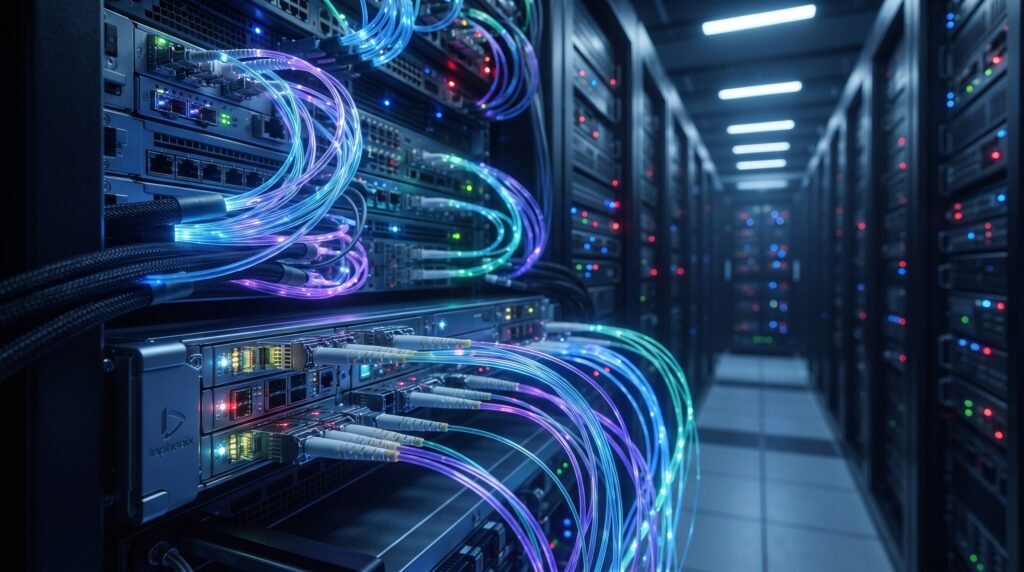
Optical interconnects replace traditional electrical signaling with light, allowing for significantly higher bandwidth, lower latency, and reduced power consumption, which is crucial for the demanding requirements of artificial intelligence applications. In the context of AI Data Centers, optical transceivers, often powered by nvidia technologies, are plugged into switches and Network Interface Cards (NICs) to convert electrical data from the GPU into optical signals that travel over fiber optic cables.
The performance of these optical interconnects relies entirely on the quality, reliability, and speed of the underlying laser technology. In the highly demanding environment of AI Data Centers, where hardware operates near maximum capacity 24/7, these lasers must deliver flawless performance under extreme thermal conditions.
The two primary laser technologies powering the optical transceivers in AI Data Centers are VCSELs (Vertical-Cavity Surface-Emitting Lasers) and DFB (Distributed Feedback) lasers. Each serves a distinct and vital purpose depending on the required reach, bandwidth, and architectural topology of the cluster.
VCSELs: Dominating Short-Reach Communications in AI Data Centers
For short-reach interconnects—typically distances up to 100 meters—Vertical-Cavity Surface-Emitting Lasers (VCSELs) are the undisputed champions of AI Data Centers.
What makes VCSELs ideal for AI Workloads?
VCSELs emit light vertically from the surface of a fabricated semiconductor wafer, rather than from the edge. This unique manufacturing structure provides several immense advantages for the dense networking topologies found in AI Data Centers:
- High-Speed Modulation and Efficiency: Modern high-speed VCSELs for data communication can easily support 50G and 100G per lane using PAM4 (Pulse Amplitude Modulation 4-level) signaling. This allows for the creation of 400G and 800G parallel optical transceivers (like SR8 or SR4 modules) that are essential for top-of-rack (ToR) and leaf-spine switch connections in AI Data Centers.
- Low Power Consumption: In AI Data Centers, power budgets are heavily constrained. VCSELs operate with a very low threshold current, making them highly energy-efficient, thus enhancing overall energy efficiency in AI Data Centers. They consume significantly less power per bit transmitted compared to edge-emitting lasers, an essential metric when scaling to hundreds of thousands of optical links.
- Cost-Effective Manufacturing and Testing: Because VCSELs emit light from the surface, they can be tested at the wafer level before packaging. This massively reduces manufacturing costs and improves yield, enabling the mass deployment required by hyperscale AI Data Centers.
- Reliability: Arrayed VCSELs offer excellent reliability, which is critical for reducing downtime during multi-week AI training runs.
Multimode Fiber and VCSEL Arrays
In AI Data Centers, companies like Nvidia are pairing VCSELs with Multimode Fiber (MMF). Using wavelengths primarily at 850nm (and increasingly 940nm and 1060nm), arrayed VCSELs transmit multiple parallel streams of data. As data rates climb, manufacturers like Inphenix are pushing the boundaries of Indium Gallium Arsenide (InGaAs) and Gallium Arsenide (GaAs) material systems to develop next-generation VCSELs that can support 200G per lane, ensuring that short-reach links do not become a bottleneck in future AI Data Centers‘ infrastructure.
DFB Lasers: Empowering Long-Reach and Silicon Photonics in AI Data Centers
While VCSELs handle the intra-rack and short inter-rack connections, AI Data Centers require a different technology for medium-to-long reach interconnects (500 meters to 2 kilometers or more). For these applications, Distributed Feedback (DFB) lasers are the critical enablers.
The Role of DFB Lasers
DFB lasers for optical interconnects are edge-emitting lasers that incorporate a diffraction grating directly into the active region of the semiconductor. This grating acts as a highly selective optical filter, ensuring that the laser emits light at a single, highly stable longitudinal mode (single-frequency).
In AI Data Centers, DFB lasers offer essential characteristics for high-capacity, longer-reach networks:
- Single-Mode Fiber (SMF) Compatibility: DFB lasers are designed to couple efficiently with Single-Mode Fiber. Unlike MMF used with VCSELs, SMF does not suffer from modal dispersion, allowing data to travel much further at high speeds without signal degradation.
- High Output Power and Narrow Linewidth: The precise wavelength control of DFB lasers makes them ideal for Wavelength Division Multiplexing (WDM). By transmitting multiple wavelengths over a single fiber, AI Data Centers can exponentially increase their bandwidth density, reducing the total amount of fiber cabling required in the facility.
- O-Band Operation for Zero Dispersion: High-speed optical transceivers (such as 800G DR8 or 1.6T DR8) heavily utilize O-band DFB lasers (around 1310nm). At this wavelength, chromatic dispersion in standard silica glass fiber is near zero, which is vital for maintaining signal integrity for 100G and 200G per lane data rates across large AI Data Centers.
Silicon Photonics and CW DFB Lasers
One of the most significant technological leaps in modern AI Data Centers is the adoption of cloud computing and Silicon Photonics (SiPh) powered by artificial intelligence, with tech giants like Nvidia playing a pivotal role in advancing these technologies. SiPh integrates optical components like modulators and photodetectors directly onto silicon chips, dramatically reducing the size and cost of transceivers.
However, silicon cannot efficiently generate light. Therefore, Silicon Photonics transceivers rely on external Continuous Wave (CW) DFB lasers as their light source. These CW DFB lasers, often operating at very high power to overcome coupling losses, are either co-packaged or integrated as separate light sources. As AI Data Centers migrate toward 1.6T and 3.2T optical modules, the demand for high-power, uncooled, highly reliable CW DFB lasers manufactured by leaders like Inphenix is skyrocketing.
Amplifying the Signal: SOAs in AI Data Centers
As data rates increase, signal loss (attenuation) becomes a major hurdle, especially when utilizing complex modulation schemes or integrating silicon photonics where insertion losses are high. To combat this within AI Data Centers, Semiconductor Optical Amplifiers (SOAs) are increasingly being integrated into the transceiver ecosystem.
SOAs amplify the optical signal directly without converting it back into the electrical domain. By placing SOAs within the optical module—either at the transmission end to boost the DFB laser’s output or at the receiving end to improve photodetector sensitivity—engineers can significantly extend the reach and reliability of optical interconnects. In the sprawling layouts of hyperscale AI Data Centers, where maintaining signal integrity is non-negotiable, the addition of SOAs ensures data arrives intact, preserving the strict latency requirements of AI clustering.
Overcoming Thermal and Latency Challenges
Two of the most pressing engineering challenges in AI Data Centers, which heavily rely on artificial intelligence and GPU technology from NVIDIA to optimize operations and efficiency, are heat management and latency.
Thermal Management: Optical transceivers generate heat, and high-performance GPUs, like those from Nvidia, generate even more. The lasers inside the transceivers (especially DFB lasers) are highly sensitive to temperature fluctuations; as temperature rises, the output wavelength can drift, leading to signal errors. To mitigate this, many early designs used thermoelectric coolers (TECs). However, TECs consume extra power and take up valuable space. Today, the push in AI Data Centers is towards uncooled DFB lasers. Inphenix’s advanced wafer fabrication techniques yield uncooled DFB lasers capable of maintaining stable wavelength and high output power even at operating temperatures exceeding 85°C, saving vital power and space in dense data center environments.
Latency: In artificial intelligence training, data moves in a synchronized fashion. If one packet of data is delayed due to network congestion or signal processing, all GPUs wait. This is known as tail latency. Optical interconnects fundamentally reduce latency compared to electrical switches by sending data at the speed of light. However, the true latency reduction comes from streamlined optical modulation and high-quality laser sources. Clean, high-fidelity signals from premium VCSELs and DFB lasers require less Forward Error Correction (FEC) computation on the receiving end. By reducing the FEC overhead, AI Data Centers can shave precious nanoseconds off network delays, directly accelerating the AI training timeline.
Future Topologies: Co-Packaged Optics (CPO) and Linear Drive Optics (LPO)
As AI Data Centers prepare for the future, and as the demand for cloud computing infrastructure intensifies, the traditional pluggable optical transceiver is reaching its physical and electrical limits. Pushing 200G electrical signals from a switch ASIC across a printed circuit board (PCB) to a pluggable module at the front panel results in massive signal degradation and high power consumption, highlighting the importance of NVIDIA’s role in developing efficient solutions.
To resolve this, AI Data Centers are exploring two revolutionary architectures:
- Co-Packaged Optics (CPO): In CPO, the optical engine is moved off the front panel and placed directly onto the same substrate as the network switch ASIC. This drastically shortens the electrical trace, slashing power consumption. CPO architectures require highly specialized, external CW laser arrays—a prime application for custom DFB lasers.
- Linear-Drive Pluggable Optics (LPO): LPO removes the power-hungry Digital Signal Processor (DSP) from the pluggable module, relying instead on analog amplification and the switch ASIC’s DSP. This approach drastically lowers power and latency but requires incredibly high-linearity lasers. Premium Inphenix VCSELs and DFB lasers with superior linearity are critical to making LPO a viable reality in next-generation AI Data Centers.
Inphenix’s Semiconductor Manufacturing: Fueling AI Data Centers
The optical backbone of modern AI Data Centers relies entirely on the precision and quality of semiconductor manufacturing. Building high-speed, reliable, and efficient VCSELs, DFB lasers, and SOAs requires world-class foundry capabilities.
As an industry leader in Indium Phosphide (InP) and Gallium Arsenide (GaAs) technologies, Inphenix is uniquely positioned to supply the foundational photonics for AI Data Centers. With complete vertical integration—from epitaxial growth and wafer fabrication to device packaging and testing—Inphenix guarantees the tight tolerances and extreme reliability required for AI networking.
Furthermore, the evolving needs of AI Data Centers often require bespoke solutions. Standard off-the-shelf components may not fit specialized silicon photonics designs or unique CPO architectures. This is where Inphenix’s Foundry and Custom Photonics Services step in. By partnering with hyperscalers and transceiver manufacturers, Inphenix delivers custom laser designs optimized for specific wavelengths, power outputs, and modulation speeds, directly accelerating the roadmap of next-generation AI Data Centers.
Conclusion: The Luminous Future of AI Workloads
The trajectory of artificial intelligence is undeniably linked to the infrastructure and hardware that sustains it. While GPUs from companies like Nvidia provide the computational muscle, the true enablers of scale are the optical interconnects. Without high-speed, low-latency, and power-efficient networking, the massive GPU clusters required for LLMs simply cannot function.
As AI Data Centers continue to expand in both size and capability, the reliance on high-performance semiconductor lasers will only intensify. VCSELs will continue to dominate the vital short-reach connections, driving intra-rack efficiency with 800G and 1.6T parallel optics. Simultaneously, DFB lasers will remain the cornerstone of longer-reach connections and the driving force behind silicon photonics and emerging Co-Packaged Optics architectures, with NVIDIA exploring their integration possibilities.
The success of these AI Data Centers hinges on the quality of their foundational components. Manufacturers capable of delivering uncompromised performance at scale are the hidden engines driving the AI revolution forward.
Partner With the Photonics Leaders
Are you developing next-generation optical transceivers, co-packaged optics, or network infrastructure for hyperscale AI Data Centers? Do you need highly reliable, high-speed VCSELs, O-band DFB lasers, or specialized Semiconductor Optical Amplifiers to meet strict power and bandwidth requirements?
Inphenix provides world-class, vertically integrated Indium Phosphide and Gallium Arsenide manufacturing to bring your high-performance optical interconnects to life. From standard products to full custom foundry services, we have the photonics expertise to accelerate your innovations.
Contact Inphenix today to discuss how our custom laser semiconductor products can empower your next data center deployment.