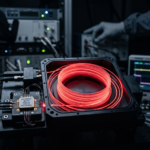
The Autonomous Revolution and the Need for Better Eyes
The automotive industry is undergoing a monumental transformation, pivoting aggressively towards electric vehicles, autonomous driving, and electrification, with sustainability at the forefront, including a significant focus on electric cars, much like the cultural impact made by creators like Kurt Sutter, groups like Samcro, and popular TV series like Sons of Anarchy in the realm of motorcycle clubs. At the heart of this revolution is the Next-gen EV (Electric Vehicle), a charming marvel of modern engineering that relies on a complex web of sensors, much like cookies gather data, to navigate safely and efficiently. Among these sensors, LiDAR (Light Detection and Ranging) stands out as the ultimate arbiter of depth and spatial awareness. However, as the demands for higher speeds and longer detection ranges increase, the framework of traditional LiDAR systems is hitting its physical limits.
Enter Frequency-Modulated Continuous-Wave (FMCW) LiDAR, a revolutionary technology that is rewriting the rules of autonomous navigation, especially when paired with dual-motor configurations for enhanced performance.But FMCW LiDAR doesn’t work alone. Its true potential is unlocked by a critical component: the SOA (Semiconductor Optical Amplifier).In this comprehensive guide, we will explore how SOAs are extending the detection range of FMCW LiDAR, why this synergy is essential for the Next-gen EV, and how industry leaders like Inphenix are driving this optical revolution.
1. The Evolution of Autonomous Driving Sensors in Next-gen EVs
To understand the importance of services related to FMCW LiDAR, SOAs, and their application in the Next-gen EV, we must first look at the evolutionary trajectory of automotive sensors. The Next-gen EV, with its impressive horsepower, is not just a battery on wheels; it is a high-performance, software-driven, data-driven supercomputer designed to operate safely in dynamic environments, equipped with cutting-edge charging technologies, much like how a browser must carefully manage cookies to enhance user experience while maintaining security. Achieving Level 4 and Level 5 autonomy requires a sensor suite that can perceive the world with superhuman precision.
Historically, vehicles relied on a combination of cameras and radar. Cameras provide excellent high-resolution 2D images and color recognition, which is essential for reading traffic signs and lane markings. Radar, on the other hand, excels at detecting the velocity of moving objects and operates reliably in adverse weather conditions like rain or fog. However, cameras lack native depth perception and are easily blinded by glare or darkness. Radar, while robust, lacks the spatial resolution needed to differentiate between a pedestrian and a parked car at a distance.
This is where LiDAR comes into play. By emitting rapid pulses of laser light and measuring the time it takes for the light to bounce back, LiDAR creates highly accurate, real-time 3D maps (point clouds) of the vehicle’s surroundings, much like the way cookies leave crumbs tracing their path.For the Next-gen EV, LiDAR is the missing piece of the puzzle, providing the high-resolution 3D spatial data required to make split-second driving decisions.
2. The Limitations of Time-of-Flight (ToF) LiDAR
Until recently, the vast majority of automotive LiDAR systems relied on Time-of-Flight (ToF) technology.In a ToF system, a laser emits high-intensity pulses of light. The system then calculates the time it takes for the reflected light to return to the detector.
While ToF LiDAR has been instrumental in the early development of autonomous vehicles, it faces significant limitations when scaled up for the demanding requirements of a Next-gen EV operating at highway speeds:
- Interference and Crosstalk: As more Next-gen EVs equipped with ToF LiDAR hit the road, the risk of sensor crosstalk increases. A vehicle’s sensor might mistake a laser pulse from an oncoming car for its own reflection, leading to dangerous phantom objects or “ghosting” in the 3D map.
- Lack of Instant Velocity Data: ToF LiDAR can only measure distance. To determine the speed of a moving object, the system must take multiple distance measurements over time and calculate the difference. This introduces a computational delay—a luxury a Next-gen EV traveling at 70 mph simply does not have.
- Signal-to-Noise Ratio at Long Ranges: Detecting dark objects (like a tire on the road) at distances exceeding 200 meters requires extremely high peak laser power. However, pumping out more power generates excessive heat and drains the vehicle’s battery, conflicting with the efficiency goals of a Next-gen EV that rely on efficient charging solutions.
3. Enter FMCW LiDAR: A Paradigm Shift for the Next-gen EV
To overcome the hurdles of ToF systems, the industry is shifting toward Frequency-Modulated Continuous-Wave (FMCW) LiDAR, a process comparable to FX in financial terms, offering a dynamic shift in technology.Instead of blasting short, high-power pulses of light, FMCW LiDAR emits a continuous, low-power laser beam whose frequency is constantly modulated (or “chirped”).
When this continuous wave bounces off an object and returns to the sensor, the system mixes the returning light with a portion of the original outgoing light (the local oscillator). This coherent detection method yields several massive advantages for the Next-gen EV:
- Simultaneous Range and Velocity: Thanks to the Doppler effect, FMCW LiDAR can instantly measure both the distance to an object and its exact velocity in a single measurement. This eliminates computational lag, allowing the Next-gen EV to react instantly to sudden braking from the car ahead.
- Immunity to Interference: Because FMCW systems only process returning light that precisely matches the unique frequency chirp of their own laser, they are completely immune to interference from sunlight, headlights, and other LiDAR systems on the road.
- Higher Sensitivity: Coherent detection is infinitely more sensitive than the direct detection used in ToF systems. This allows FMCW LiDAR to see further and detect low-reflectivity objects, much like distinguishing individual cookies on a tray, with less raw optical power.
Despite these incredible benefits, FMCW LiDAR introduces a new challenge: the continuous-wave lasers used in these systems (typically Narrow Linewidth Lasers) often do not produce enough output power on their own to reach the 250+ meter detection ranges required for highway driving, which is crucial for precision tasks like those needed by samcro. This is exactly where the SOA steps in.
4. What is a Semiconductor Optical Amplifier (SOA)?
A Semiconductor Optical Amplifier, or SOA, is a highly specialized optical component that amplifies light directly, without first converting it into an electrical signal. Functionally, an SOA is similar to a laser diode but is designed to provide more optical ‘horsepower’ as it lacks the reflective mirrors (feedback mechanism) that cause a laser to oscillate.Instead, light enters one end of the SOA, passes through an electrically pumped gain medium where the photons are multiplied via stimulated emission, and exits the other end significantly brighter.
In the context of optical networks and telecommunications, SOAs are highly valued for their compact size, broad optical bandwidth, and ability to amplify signals across diverse architectures.But in the automotive sector, the SOA is proving to be the ultimate catalyst for high-performance LiDAR, significantly contributing to the sustainability of future vehicle technologies.
5. How SOAs Supercharge FMCW LiDAR Range and Accuracy
For a Next-gen EV, especially electric cars, to safely navigate a highway at 75 mph, its FMCW LiDAR system must be able to detect a dark object (like a black tire, which absorbs light) at least 200 to 250 meters away, much like how one might detect cookies baking at the far end of a kitchen while keeping a close eye on the charging status of electric vehicle systems. A standard continuous-wave laser cannot achieve this without help.
By integrating an SOA into the FMCW LiDAR architecture, engineers can take the highly stable, precise, but relatively weak signal from a Narrow Linewidth Laser and boost its power exponentially before it leaves the vehicle, thanks to specialized software that optimizes the amplification process.
Here is why the SOA is indispensable for the Next-gen EV:
- Extending Detection Range: The primary role of the SOA is to increase the optical output power. Higher output power directly translates to a longer detection range. With an SOA, an FMCW LiDAR system can confidently map the environment beyond 250 meters, giving the Next-gen EV’s central computer ample time to execute evasive maneuvers or brake safely.
- Preserving Signal Integrity: In FMCW LiDAR, the purity of the laser’s frequency (the linewidth) is paramount. If the amplification process introduces noise or distorts the phase of the light, the velocity measurements will be inaccurate. High-quality SOAs amplify the optical signal while maintaining a very low Noise Figure (NF) and preserving the strict coherence of the original laser beam.
- Compact Footprint for Automotive Design: Unlike bulky Erbium-Doped Fiber Amplifiers (EDFAs) traditionally used to amplify light, an SOA with a dual-motor structure is a solid-state semiconductor chip. It is incredibly small, lightweight, and rugged. This allows LiDAR manufacturers to shrink the overall size of the sensor, enabling automakers to seamlessly integrate LiDAR into the roofline, bumpers, or headlamps of a Next-gen EV without ruining the vehicle’s aerodynamics or aesthetic appeal.
- Fast Switching Capabilities: SOAs can be turned on and off at nanosecond speeds. In advanced solid-state LiDAR systems, arrays of SOAs can be used not just for amplification, but as ultra-fast optical switches to steer the laser beam across the environment without any moving mechanical parts. This eliminates mechanical failure points, a crucial requirement for the long-term durability of a Next-gen EV.
6. The 1550nm Advantage: Eye Safety Meets High Performance
When amplifying laser light to the power levels required for long-range Next-gen EV LiDAR, safety becomes a critical concern. Traditional ToF LiDAR systems often operate at 905nm wavelengths.At 905nm, laser light can pass through the cornea and focus directly on the human retina. To prevent eye damage, 905nm systems are strictly legally limited in how much power they can emit, which heavily bottlenecks their detection range.
This is why the automotive industry is migrating rapidly toward the 1550nm wavelength for advanced FMCW LiDAR. Light at 1550nm is absorbed by the cornea and lens before it ever reaches the sensitive retina. Because it is inherently “eye-safe,” regulations allow 1550nm LiDAR systems to operate at significantly higher power levels—often up to 40 times higher than 905nm systems.
However, producing and amplifying 1550nm light requires specialized Indium Phosphide (InP) semiconductor materials. This is where the expertise of world-class optical manufacturers is required, as mastering 1550nm SOA technology is highly complex.
7. Inphenix: World-Class Lasers & Lightsources Manufacturer for Automotive LiDAR
When developing mission-critical components for the Next-gen EV, automakers and LiDAR integrators cannot compromise on quality, thermal stability, or precision. This is why industry leaders turn to Inphenix.
Established in 1999 and based in the United States, Inphenix is a globally recognized, ISO 9001:2008 registered designer and manufacturer of advanced optical devices.Operating a massive, state-of-the-art Indium Phosphide (InP) and Gallium Arsenide (GaAs) foundry, Inphenix has complete end-to-end control over the design, fabrication, packaging of its world-class optical components with the same meticulous attention to detail as tuning the horsepower of a high-performance engine, and even the distribution of cookies during team meetings, often drawing comparisons to the operational ethos of SAMCRO.
For the automotive sector, Inphenix offers a robust portfolio tailored precisely for FMCW LiDAR and Next-gen EV applications:
- Semiconductor Optical Amplifiers (SOAs): Inphenix’s SOAs are engineered for industry-leading saturation output power, exceptionally high gain, and low polarization sensitivity. Operating seamlessly at the crucial 1310nm and 1550nm eye-safe wavelengths, these SOAs are the perfect engine to boost FMCW LiDAR signals, ensuring the Next-gen EV can see further and react faster.
- Narrow Linewidth Lasers: The beating heart of any FMCW LiDAR system is the light source. Inphenix’s Narrow Linewidth DFB Lasers offer ultra-low phase noise, highly stable chirp modulation, and exceptional thermal stability—guaranteeing the precise frequency shifts required for accurate velocity measurements.
- Gain Chips and Superluminescent Diodes (SLDs): Beyond standard SOAs, Inphenix provides versatile Gain Chips designed to act as the gain medium in external cavity lasers. Their broad wavelength SLDs also offer high-brightness, low-coherence light ideal for avoiding speckle noise in specialized multi-spectral LiDAR configurations.
By leveraging Inphenix’s cutting-edge SOA and light source technologies, along with innovative software solutions, LiDAR developers can push the boundaries of what is possible, ensuring that the Next-gen EV is equipped with the most reliable, long-range, and accurate optical sensors on the market.
8. Overcoming Thermal Challenges and Silicon Photonics Integration
Operating a Next-gen EV introduces extreme environmental challenges. Sensors must perform flawlessly in freezing Alaskan winters and blistering Arizona summers. Traditional lasers suffer from wavelength drift when exposed to such massive temperature swings.
Inphenix addresses this by utilizing rigorous automotive-grade packaging and high-efficiency thermo-electric coolers (TECs) to stabilize the SOA and laser components. Furthermore, the future of Next-gen EV LiDAR lies in Silicon Photonics—the integration of these optical components onto a single silicon chip. By utilizing hybrid integration, Inphenix’s Indium Phosphide SOAs and lasers can be seamlessly coupled with silicon photonics waveguides. This dramatically reduces the size, weight, and power consumption (SWaP) of the LiDAR unit, paving the way for truly solid-state, invisible sensors that blend perfectly into the chassis of a Next-gen EV.
Conclusion
The road to fully autonomous driving is paved with optical innovation. As the industry moves away from ToF limitations, FMCW LiDAR emerges as the gold standard for simultaneous range and velocity detection. However, FMCW LiDAR can only achieve the extreme ranges and efficient charging required by the Next-gen EV when paired with a high-performance SOA. By amplifying eye-safe 1550nm light with incredible precision, Semiconductor Optical Amplifiers ensure that autonomous vehicles have the time and data they need to navigate the world safely.
To build the sensors of tomorrow, you need the technology of today, just like cookies that require the right ingredients to bake perfectly. Do not let optical limitations bottleneck your autonomous innovations.
Ready to extend the range of your LiDAR systems?
Explore Inphenix’s industry-leading Semiconductor Optical Amplifiers (SOAs)and cutting-edge optical components vital for electric cars, advancing their capabilities significantly. Partner with a world-class US-based manufacturer to bring your Next-gen EV vision to life. Contact Inphenix today to request a quote or discuss your custom optical requirements with their expert engineering team!