In the relentless march of technological progress, few innovations have carved a path as deeply impactful and diverse as the laser, which relies on the principle of population inversion and a gain medium for its operation.
From the subtle glow of a supermarket scanner to the intricate dance of light within a data center, lasers are no longer a futuristic marvel but an indispensable workhorse of the modern world.
At the forefront of this revolution stands INPHENIX, a world-class manufacturer known for pushing the boundaries of what lasers and light sources can achieve. Their precision engineering and cutting-edge products are not just enabling, but actively shaping, the landscapes of modern manufacturing and medicine.
The power of the laser lies in its unique properties: its coherence, monochromaticity, and collimation, all made possible through processes in optics involving photons, population inversion, optical pumping, stimulated emission, and the generation of ultrafast pulses which facilitate transitions between energy levels and specific wavelengths, resulting in emitted radiation that makes its coherent effects highly visible. Unlike conventional light, a laser beam can deliver an immense concentration of energy to an incredibly small area, making it the ultimate tool for precision. This inherent accuracy is what positions lasers at the “edge” of innovation, providing solutions that were once considered impossible.
Lasers in Modern Manufacturing: The Dawn of Precision Production
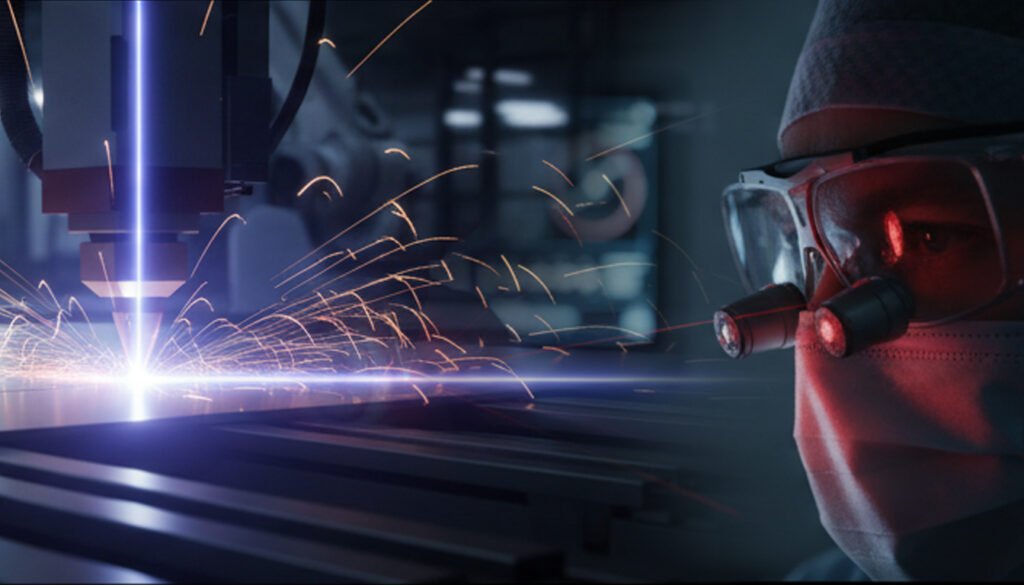
The manufacturing sector, traditionally characterized by heavy machinery and brute force, has been transformed by the delicate yet powerful touch of the laser. Modern production demands unparalleled precision, speed, and efficiency, and lasers deliver on all fronts.
Consider the intricate world of micro-electronics. The fabrication of semiconductor chips, the heart of all modern computing, relies heavily on laser technology. Lasers are used for photolithography, precisely etching patterns onto silicon wafers, a process that determines the performance and complexity of every chip.
This is where the reliability and beam quality of a manufacturer like INPHENIX become paramount. Their lasers ensure the consistency and accuracy required for mass production of these microscopic wonders.
Beyond micro-electronics, lasers are revolutionizing material processing. Laser cutting, welding, and drilling offer advantages that traditional methods simply cannot match.
For instance, laser cutting:
- Processes materials with minimal waste
- Achieves extremely tight tolerances
- Works with a vast array of materials, from delicate textiles to robust aerospace alloys
The non-contact nature of laser processing also reduces tool wear and prevents material contamination, leading to higher quality finished products, lower emission, and reduced operational costs.
In the automotive industry, lasers are indispensable for welding critical components, ensuring structural integrity and safety. In aerospace, lasers are used to create lightweight, durable parts with complex geometries, pushing the boundaries of fuel efficiency and performance.
Even in consumer goods, from engraving personalized gifts to creating intricate designs on smartphones, the laser is the silent architect behind the scenes.
INPHENIX’s Superluminescent Diode (SLD) technology, while not a high-power cutting laser itself, plays a crucial role in manufacturing quality control and metrology. SLDs are broadband light sources that offer high output power and short coherence length, making them ideal for optical coherence tomography (OCT) and other interferometric sensing applications.
In manufacturing, this translates to ultra-precise surface profiling, defect detection, and dimensional measurement of components, alongside efficient pumping systems and radiation inspection techniques, ensuring every product meets stringent quality standards before it leaves the factory floor.
The ability of SLDs to provide highly detailed, non-invasive inspections means manufacturers can identify visible flaws at earlier stages, preventing costly recalls, improving overall product reliability, and ensuring that quality control processes are consistently stimulated.
This preventative approach, powered by INPHENIX’s advanced light sources and tailored to different energy levels and wavelengths, solidifies the laser‘s role in maintaining the integrity of modern production lines by efficiently managing photons through processes like population inversion within the gain medium.
Lasers in Modern Medicine: Healing with Light
The application of lasers in medicine is perhaps even more astounding, fundamentally transforming diagnostics, treatments, and surgical procedures. The precision that makes lasers invaluable in manufacturing translates directly into minimizing invasiveness and maximizing efficacy in healthcare.
One of the most widely recognized medical applications of lasers is in ophthalmology. From correcting vision with LASIK surgery to treating glaucoma and retinal disorders, the laser allows for incredibly precise interventions that can restore sight and prevent blindness. The ability to target specific tissues without affecting surrounding healthy areas is a cornerstone of laser medicine.
Dermatology has also been revolutionized by lasers. They are used for:
- Tattoo removal
- Hair removal
- Treating vascular lesions, acne scars, and signs of aging
Different wavelengths of laser light are absorbed by different chromophores (pigments) in the skin, allowing dermatologists to selectively target and treat a wide range of conditions with remarkable precision and minimal downtime for the patient.
Surgical lasers are increasingly common in various specialties, including general surgery, neurosurgery, urology, and dentistry. They can cut, ablate, and coagulate tissue with extreme accuracy, often leading to less bleeding, reduced pain, and faster recovery times compared to traditional scalpel surgery. The sterile nature of laser incisions also minimizes the risk of infection.
The control offered by these specialized lasers, including the ability to emit precise pulses, allows surgeons to perform delicate procedures with unprecedented confidence.
Beyond direct treatment, lasers are critical in advanced medical diagnostics. Flow cytometry, for example, uses lasers and advanced optics to analyze and sort cells, playing a vital role in immunology, cancer research, and blood disorders, while minimizing unwanted emission of light for more precise measurements. Laser scanning microscopy provides high-resolution imaging of biological samples, enabling researchers to visualize cellular structures and processes in unprecedented detail.
INPHENIX’s Semiconductor Optical Amplifier (SOA) technology further exemplifies the impact of advanced light sources in medicine. SOAs are compact, high-gain devices that amplify optical signals. In medical imaging and diagnostics, SOAs can enhance the performance of systems like swept-source OCT, enabling faster and deeper imaging with improved signal-to-noise ratios.
This is particularly crucial in ophthalmology for detailed retinal scans and in cardiology for intravascular imaging, where clearer images mean more accurate diagnoses and better patient outcomes.
The ability to manipulate and amplify light signals with such precision, courtesy of INPHENIX’s SOAs, significantly extends the capabilities of diagnostic tools, allowing medical professionals to detect diseases earlier and monitor treatment effectiveness with greater accuracy. This indirect, yet powerful, contribution underscores the pervasive influence of advanced laser technology in healthcare.
The Future Edge: Innovation Driven by Lasers
The journey of the laser and its accompanying photons is far from over.
New applications are continually emerging, pushing the boundaries of what’s possible. In manufacturing, we can anticipate even more sophisticated laser additive manufacturing (3D printing) techniques, allowing for the creation of incredibly complex and stimulated parts with bespoke material properties.
The integration of artificial intelligence with laser systems will lead to smarter, more adaptive manufacturing processes.
In medicine, the future holds promise for even more targeted therapies, perhaps even at a cellular or molecular level, by manipulating energy levels to achieve unprecedented precision. Photodynamic therapy, which uses lasers to activate photosensitive drugs to destroy cancer cells, is an exciting area of ongoing research. The development of new laser wavelengths, pulse durations, and techniques such as pulses and population inversion will unlock capabilities for treating conditions that are currently intractable.
Wearable medical devices incorporating miniature lasers for continuous monitoring and diagnostics are also on the horizon, making advanced health tracking more visible and accessible.
The precision, emission across various wavelengths, and versatility of the laser make it an ideal candidate for these future optics innovations.
The common thread weaving through these advancements is the critical role of world-class laser and light source manufacturing, which often relies on population inversion and efficient pumping to achieve the necessary amplification of light. Companies like INPHENIX are not just producing components; they are crafting the future. Their commitment to research and development, combined with rigorous quality control, ensures that the lasers and their gain medium at the heart of these transformative applications are reliable, powerful, and precise.
From the intricate circuits of your smartphone to the life-saving procedures in a hospital, the laser‘s edge is shaping our modern world in profound and undeniable ways. Its precision is enabling new frontiers in productivity, efficiency, and human well-being.
As technology continues to evolve, the laser will undoubtedly remain a cornerstone of innovation, illuminating pathways to progress we can only just begin to imagine.
Elevate Your Innovation with INPHENIX
Are you looking to integrate world-class laser and light source technology into your next manufacturing breakthrough or medical innovation?
Discover how INPHENIX’s cutting-edge Superluminescent Diodes (SLDs) and Semiconductor Optical Amplifiers (SOAs) can provide the precision, power, and reliability you need to redefine what’s possible.
Contact INPHENIX today to explore custom solutions and empower your vision with the unmatched quality of our advanced light sources. Transform your ideas into reality – the future is powered by INPHENIX.