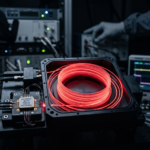
When the term VCSELs (Vertical-Cavity Surface-Emitting Lasers) is mentioned, it is often associated with consumer-grade facial recognition. However, narrowing the definition of this technology to biometric scanning ignores the profound physics-based evolution occurring in photonics. VCSELs represent a paradigm shift in semiconductor laser design, offering unique spatial and temporal coherence properties that are transforming industrial, medical, and data-center architectures.
By leveraging Inphenix VCSELs, engineers are now solving complex problems in high-speed data transmission, atomic sensing, and non-invasive medical imaging. This article delves into the underlying physics that make these devices the cornerstone of next-generation optical engineering.
The Physics of VCSELs: A Vertical Cavity Architecture
To understand why VCSELs have become a critical industrial component, we must analyze their structure, including the integration of quantum wells. Unlike traditional Edge-Emitting Lasers (EELs) that rely on cleaved facets to form a cavity along the semiconductor surface, VCSELs utilize Distributed Bragg Reflectors (DBRs) to create an optical cavity perpendicular to the semiconductor wafer.
These DBR mirrors consist of alternating layers of high and low refractive index materials, each with an optical thickness of a quarter-wavelength ($\lambda/4$).This periodic structure creates a “photonic bandgap” that reflects light with near-perfect efficiency, forming the high-quality resonator required for lasing.
This architecture results in a low-divergence, symmetric, circular beam profile with low power consumption.For engineers integrating Inphenix VCSEL products into sensitive optical trains, this circular emission is a massive advantage; it allows for high-efficiency coupling into multi-mode and single-mode fibers without the need for complex, bulky beam-shaping optics. Furthermore, because of their compact size, the laser cavity is formed epitaxially, and thousands of these devices can be fabricated and tested at the wafer level—a distinct advantage over the individual handling required for edge-emitters.
For a comprehensive technical analysis of this architecture, explore the Inphenix guide to modern laser technology.
How VCSELs Enable Advanced LiDAR and Autonomous Sensing
The role of VCSELs in autonomous navigation goes far beyond simple distance measurement. LiDAR (Light Detection and Ranging) systems rely on the ability to fire nanosecond-scale pulses of light to map a 3D environment in real-time.
The physics of Inphenix VCSEL technology utilizes quantum wells to support extremely high-frequency modulation. Because the cavity volume is tiny, the carrier density can be modulated with minimal parasitic capacitance, allowing for rise and fall times in the sub-nanosecond range.This translates to higher resolution in point-cloud generation. Additionally, in outdoor environments, Inphenix VCSELs demonstrate superior wavelength stability over a wide temperature range, ensuring that the LiDAR receiver’s narrow bandpass filter remains perfectly aligned with the laser’s emission wavelength, effectively suppressing solar background noise.
Industrial Applications of VCSELs in Material Processing
In precision manufacturing, VCSELs are beginning to disrupt traditional thermal processing. While high-power fiber lasers are standard for deep cutting, the high-density array configuration of Inphenix VCSELs provides a unique capability for large-area, uniform heating.
Because VCSELs can be densely packed into 2D arrays, they provide a power density that is easily controlled spatially, while ensuring low power consumption. This allows for precise, non-contact annealing and rapid thermal processing of semiconductor materials. By adjusting the current to specific sections of the array, manufacturers can create variable power maps across a target, offering unprecedented control in thin-film processing and specialized micro-fabrication. Unlike convection ovens or lamps, these arrays provide instant, high-brightness, and energy-efficient irradiation, making them an ideal “light-source tool” for industrial sintering, curing, and welding.
To learn more about how these components are utilized in high-precision settings, review our technical resources on high-performance diode components.
VCSELs in Medical Diagnostics and Spectroscopy
The field of medical diagnostics is moving rapidly toward point-of-care (POC) testing, which demands miniaturized, low-power light sources and benefits greatly from the compact size of these components. VCSELs are uniquely suited for these applications due to their low threshold current and minimal power consumption.
In techniques like Optical Coherence Tomography (OCT), the stability of the light source is the limiting factor for image resolution. Inphenix VCSELs provide a highly stable, low-noise output that allows for deeper penetration in biological tissues and sharper axial resolution in diagnostic imaging. By integrating these lasers into compact diagnostic systems of compact size, medical professionals can perform high-fidelity imaging in environments that were previously inaccessible to bulky, lab-grade equipment.
The Future: Integrating VCSELs into AI Infrastructure
As we move into 2026 and beyond, the bottleneck for AI infrastructure has shifted from compute power to data interconnect bandwidth. Traditional copper interconnects struggle with heat dissipation and signal degradation at high frequencies.
The industry is pivoting toward short-reach optical interconnects, where Inphenix VCSEL products act as the primary light source.The combination of high-speed modulation, low power consumption, and the ability to integrate directly onto silicon photonics platforms makes them the only viable solution for the massive parallelization required by modern GPU clusters. We are currently seeing a transition where VCSELs are not just a peripheral component, but the fundamental engine driving data movement within data centers. Whether through “wide-and-slow” architectures or high-speed PAM4 links, VCSELs ensure that the communication layers of an AI system can keep pace with the exponential growth in demand.
We invite you to view our full product portfolio and customization servicesto see how our engineering team can optimize your hardware configurations for the next wave of high-bandwidth infrastructure.
Advancing Your Technical Roadmap
As photonics continues to underpin the most critical technological advancements—from the quantum computer to the autonomous vehicle—the choice of laser source remains the most important design decision an engineer can make. Inphenix is dedicated to pushing the physical limits of semiconductor laser performance to ensure that your innovations have the reliability and precision they require to scale.
Contact the Inphenix Engineering Team today to discuss your specific technical requirements, evaluate custom chip design possibilities, or request a consultation on how to integrate our high-performance laser technology into your next-generation system.