In the fast-evolving landscape of high-speed optical communications, sensing, optical networking, data centers, and industrial laser applications, optics play a crucial role, and precision, amplification, and regeneration are everything. Semiconductor Optical Amplifiers (SOAs) serve as the backbone of modern photonic systems, offering the high gain and wide bandwidth necessary for complex signal processing.
However, because Semiconductor Optical Amplifiers (SOA) are sophisticated optoelectronic devices, parameters like noise figure are critical and they are sensitive to environmental conditions, handling, and operational stresses.
For engineers and system integrators, understanding how to diagnose and troubleshoot these components is essential to maintaining system integrity. This guide explores common failure modes and provides actionable troubleshooting tips to ensure your Inphenix high-performance SOAs deliver consistent, world-class performance.
Understanding the Role of Semiconductor Optical Amplifiers (SOAs)
Before diving into troubleshooting, it is important to recognize why Semiconductor Optical Amplifiers are so critical. An SOA is essentially a laser diode structure designed without the feedback cavity, allowing for optical amplification through stimulated emission, though it can experience gain saturation under certain conditions.
Why Quality Matters
When integrating semiconductor optical amplifiers (SOA) into your design, the quality of the chip fabrication—such as the anti-reflective coatings and the material purity—directly dictates the device’s lifespan and reliability.
Inphenix utilizes state-of-the-art manufacturing to minimize intrinsic defects, but even the best devices require careful handling during integration.
Common Failure Modes of Semiconductor Optical Amplifiers
If you notice a degradation in signal quality, it is vital to categorize the potential issues into three main buckets: environmental, electrical, or mechanical.
1. Facet Damage and Contamination
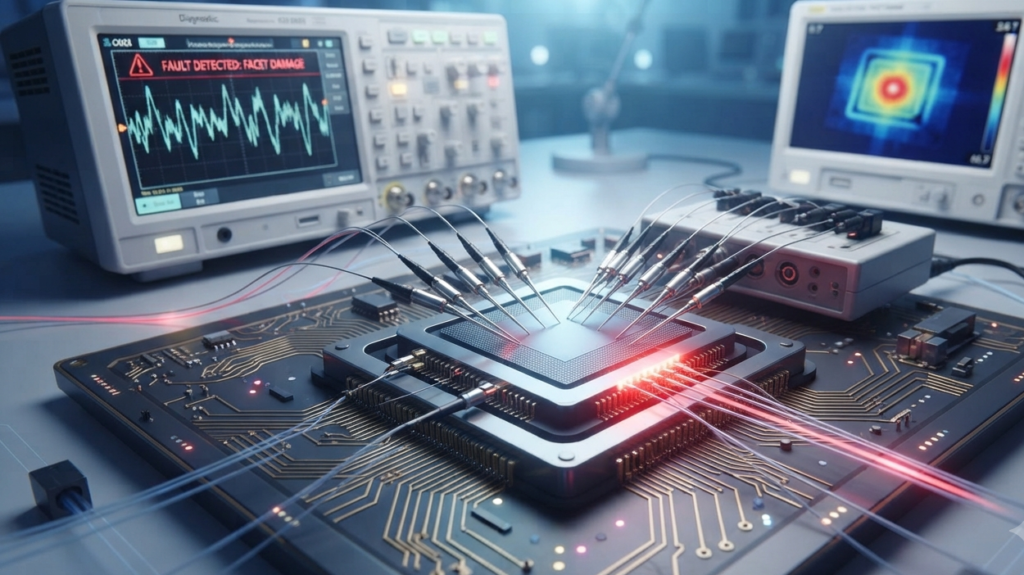
The facets (the input and output ends) of Semiconductor Optical Amplifiers (SOA) are the most sensitive regions.
Even microscopic dust particles or organic residues can cause local heating when the device is operated at high power, especially in high bandwidth applications, leading to catastrophic optical mirror damage (COMD).
2. Electrostatic Discharge (ESD)
Like many high-end optoelectronics, an SOA is highly susceptible to ESD.
A single event can cause subtle damage to the active region, which might not cause immediate failure but will lead to accelerated degradation over time.
3. Thermal Stress and Over-Driving
Operating Semiconductor Optical Amplifiers (SOAs) outside their recommended temperature ranges or exceeding the maximum injection current can lead to thermal runaway. High temperatures and excess light exposure degrade the crystal structure and the metal contacts, significantly shortening the operational lifespan and hindering regeneration processes.
Troubleshooting Checklist for SOA Devices
When performance dips, follow this systematic approach to isolate the issue.
Step 1: Physical Inspection and Connector Integrity
Many “device failures” turn out to be issues with fiber coupling.
- Check Connectors: Inspect the fiber pigtails for debris. Clean connectors using industry-standard optical cleaning tools.
- Check Fiber Integrity: Ensure there are no sharp bends or micro-kinks in the fiber pigtails that might be inducing excess loss.
Step 2: Power and Gain Analysis
If the SOA is exhibiting low output power, use an optical spectrum analyzer to monitor the gain profile, check for amplification issues, and evaluate for gain saturation.
- Low Gain: This often points to insufficient injection current or degradation of the active medium due to long-term over-driving.
- Increased Noise Floor: If the SOA shows excessive Amplified Spontaneous Emission (ASE), assess the noise figure to ensure it’s within acceptable limits and verify that your input signal levels are within the intended operating range. Overloading the device will lead to saturation and signal distortion.
Step 3: Electrical Driver Verification
Verify that your laser driver is providing a clean, stable current, especially important in data centers and high bandwidth applications involving optical networking and optics. Fluctuations in the drive current—or high-frequency noise from a poorly filtered power supply—can manifest as unstable optical output or accelerated component aging.
Best Practices for Maximizing SOA Longevity
To ensure your Semiconductor Optical Amplifiers (SOA) last their full design life, implement these preventive measures:
- Maintain Temperature Control: Always operate the SOA with precise Thermoelectric Cooler (TEC) control. Stable thermal management is the single most important factor in preventing long-term degradation.
- ESD Protocols: Implement strict ESD-safe handling procedures in your laboratory or production line. Use grounded wrist straps and anti-static mats whenever handling Semiconductor Optical Amplifiers.
- Monitor Input Power: Avoid “hot-swapping” or injecting high-power pulses into an SOA that is not powered on. Always ramp up the current slowly to avoid thermal shock to the chip.
Choosing the Right Hardware for Your Application
Sometimes, the “failure” is simply a mismatch between the device specifications and the application requirements.
When selecting your next Semiconductor Optical Amplifier (SOA), consider the following parameters offered by Inphenix’s world-class engineering team:
- Saturation Output Power: Ensure the SOA can handle the peak power of your light signal without entering deep saturation, and be aware of conditions that may lead to gain saturation.
- Polarization Dependent Gain (PDG): For fiber-optic communications, minimal PDG is essential to prevent signal fading.
- Gain Bandwidth: Ensure the SOA provides high bandwidth to cover the spectral requirements of your swept wavelength light source or other optical subsystems.
Leveraging Inphenix Expertise
If you are struggling with the optics involved in achieving the desired performance in optical networking or optimizing data centers with SOA technology, don’t hesitate to consult with the manufacturer. Inphenix doesn’t just supply Semiconductor Optical Amplifiers; we provide design support to ensure that your integration—whether in medical imaging, fiber sensing, or telecom—is optimized for regeneration and success.
Summary of Maintenance and Troubleshooting
| Symptom | Probable Cause | Recommended Action |
|---|---|---|
| No Optical Output | Driver failure or broken fiber | Verify drive current; inspect pigtail |
| Low Gain | Device aging or input overload | Check bias current; verify input levels |
| Instability | Temperature drift | Check TEC controller settings |
| Excessive Noise | High ASE due to saturation | Use an attenuator at input |
By following these guidelines and utilizing high-quality Semiconductor Optical Amplifiers, you can optimize amplification, minimize downtime, and ensure the reliability of your optical systems.
For more information on specific models, including our wide range of Superluminescent Diodes (SLDs) and other photonics solutions, visit Inphenix today.
Disclaimer: This article is intended for informational purposes for professional engineers. Always refer to the specific datasheet provided by the manufacturer for the safe operating limits of your specific SOA device.
Disclaimer: This article is intended for informational purposes for professional engineers. Always refer to the specific datasheet provided by the manufacturer for the safe operating limits of your specific SOA device.