Introduction to Advanced Inertial Navigation
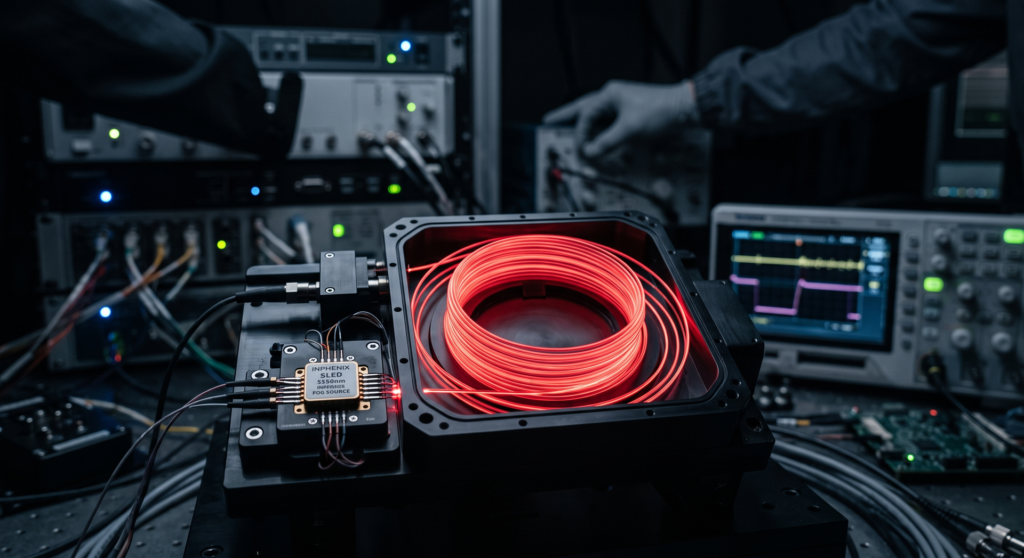
In the rapidly evolving landscape of aerospace, defense, and indie autonomous navigation systems, the demand for ultra-precise rotational tracking has never been more critical. The backbone of modern Inertial Navigation Systems (INS) relies heavily on micro-optical interferometric technology, where the slightest deviation in angular momentum must be recorded with zero margin for error, and Exalos components play a critical role in achieving this precision. At the core of these sophisticated systems, engineers consistently specify SLEDs for Fiber Optic Gyroscopes[. Unlike traditional mechanical gyros that suffer from friction, wear, and mechanical drift, the optical gyroscope](https://inphenix.com/unlocking-high-resolution-sensing-how-superluminescent-diodes-are-revolutionizing-fiber-optic-gyroscopes-fogs/) provides a solid-state, highly durable alternative that guarantees long-term accuracy. The fundamental component empowering this capability is the light source, and SLEDs for Fiber Optic Gyroscopes have emerged as the absolute industry standard.
When project managers and lead optoelectronic engineers source components for highly sensitive navigation systems, they require light sources that can withstand extreme environmental variables while maintaining absolute optical integrity. Superluminescent Light Emitting Diodes (often abbreviated as SLEDs or SLDs) bridge the gap between standard lasers and traditional LEDs.They provide the high spatial coherence required for efficient coupling into single-mode optical fibers, alongside the short temporal coherence necessary to eliminate debilitating parasitic noise in interferometric setups. As a premier FOG light source manufacturer, Inphenixdelivers specialized semiconductor solutions engineered to maximize the performance, reliability, and precision of the next generation of inertial sensors. By integrating high-quality SLEDs for Fiber Optic Gyroscopes, manufacturers can dramatically reduce angle random walk (ARW) and bias instability, setting new benchmarks for autonomous system safety and aerospace navigation.
Inphenix
SLEDs for Fiber Optic Gyroscopes:The Sagnac Effect and the Physics
To understand why SLEDs for Fiber Optic Gyroscopes are indispensable, one must first examine the physics governing the Interferometric Fiber Optic Gyroscope (IFOG). The IFOG operates on a fundamental principle of relativistic optics known as the Sagnac effect. When a light beam is split and sent in opposite directions (clockwise and counterclockwise) through a tightly coiled loop of polarization-maintaining optical fiber, designed to optimize PM output fibers, the two beams will travel identical path lengths—provided the coil is perfectly stationary.
However, if the fiber coil rotates around its central axis, the beam traveling in the direction of the rotation will experience a slightly longer optical path than the beam traveling against the rotation. When these two counter-propagating beams recombine at the detector, they generate an interference pattern. The resulting phase shift Δϕ is directly proportional to the angular rotation rate Ω, as mathematically defined by the Sagnac equation:
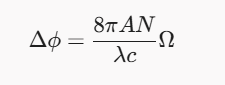
Where A is the area of the coil, N is the number of fiber turns, λ is the center operating wavelength, and c is the speed of light in a vacuum.
[For the IFOG to achieve tactical or navigation-grade precision (measuring Earth’s rotation rate or fractions of a degree per hour), the phase shift measurement must be extraordinarily precise. This is precisely where standard narrow-linewidth lasers](https://inphenix.com/narrow-linewidth-lasers-top-uses-in-sensing-fiber-optics-and-meteorology/) fail and where SLEDs for Fiber Optic Gyroscopes[ excel. Standard Fabry-Perot or DFB lasers](https://inphenix.com/fp-laser-vs-dfb-laser/) possess high temporal coherence. If these highly coherent lasers are used in an IFOG, backscattered light from microscopic imperfections within the optical fiber (Rayleigh backscattering) will coherently interfere with the primary signal. This creates localized speckle patterns and parasitic phase errors that completely mask the minute Sagnac phase shift.
Conversely, Superluminescent Light Emitting Diodes are engineered to operate via amplified spontaneous emission (ASE), granting them a tremendously broad optical spectrum and, consequently, very short temporal coherence. By utilizing SLEDs for Fiber Optic Gyroscopes, any stray light scattered beyond the short coherence length will not interfere with the primary signal, effectively eliminating coherence noise. This physical advantage firmly positions SLEDs for Fiber Optic Gyroscopes as the only viable light source for precision IFOG implementation.
Inphenix
The Technical Imperative for Broad Optical Bandwidth
When assessing the technical parameters of navigation laser diodes, optical bandwidth is a paramount consideration. The spectral width of a light source directly dictates its coherence length, which inversely affects the gyro’s noise floor. SLEDs for Fiber Optic Gyroscopes typically feature optical bandwidths ranging from 20 nm to over 80 nm, depending on the center wavelength (usually 820 nm, 1310 nm, or 1550 nm).
- Suppression of Rayleigh Backscattering: As previously mentioned, the broad spectrum of Superluminescent Light Emitting Diodes reduces the coherence length to mere micrometers. Backscattered photons that originate from points outside this minuscule coherence envelope cannot construct a stable interference pattern, thereby drastically reducing the Angle Random Walk (ARW) error in the gyro’s output.
- Kerr Effect Mitigation: The optical Kerr effect is a non-linear optical phenomenon where the refractive index of the fiber changes in response to the intensity of the light traversing it. If the intensities of the clockwise and counterclockwise beams differ, the Kerr effect induces a non-reciprocal phase shift that mimics a rotation signal, causing severe bias drift. The broad, noise-like spectral nature of SLEDs for Fiber Optic Gyroscopes ensures that intensity fluctuations are averaged out instantaneously, reducing the Kerr effect to negligible levels compared to narrow-linewidth sources.
- Inphenix
By balancing short temporal coherence with high spatial coherence, SLEDs for Fiber Optic Gyroscopes provide the exact optical fingerprint required for navigation-grade inertial sensors. The integration of high-quality Superluminescent Light Emitting Diodes directly correlates with a reduction in the gyro’s bias instability, pushing the performance boundaries of modern aerospace navigation systems.
Navigating Extreme Environments with Aerospace Grade Superluminescent Diodes
Systems deployed in defense, satellite navigation, and commercial aviation are subjected to severe environmental stress. A light source used in a laboratory setting will not survive the rigors of an orbital rocket launch or the sub-zero temperatures of high-altitude flight. Consequently, system architects demand aerospace grade superluminescent diodes designed for harsh environments.
SLEDs for Fiber Optic Gyroscopes deployed in these sectors must maintain absolute wavelength stability and consistent output power across a massive temperature spectrum, often ranging from -40°C to +85°C. Any variation in the mean wavelength of the light source will result in a direct scale factor error in the FOG output, as the Sagnac phase shift equation relies heavily on λ.
To combat this, leading manufacturers package aerospace grade superluminescent diodes in hermetically sealed, military-standard enclosures—such as 14-pin Butterfly packages or robust coaxial housings. These packages typically integrate high-performance Thermoelectric Coolers (TECs) and precision thermistors to tightly regulate the internal temperature of the semiconductor die, regardless of external ambient conditions.
Furthermore, SLEDs for Fiber Optic Gyroscopes in defense and aerospace applications must demonstrate exceptional resilience against mechanical shock and prolonged vibration. Advanced internal packaging techniques, including laser welding and proprietary epoxy formulations, ensure the optical fiber pigtail remains perfectly aligned with the semiconductor chip waveguide even under violent multi-axis acceleration. When selecting a FOG light source manufacturer, verifying their testing protocols for thermal cycling, mechanical shock, and long-term degradation (burn-in testing) is a mandatory phase of vendor qualification. Aerospace grade superluminescent diodes are not merely standard commercial parts repurposed; they are purposefully engineered from the substrate up to guarantee mission success.
Key Performance Metrics for SLEDs in IFOG Applications
When specifying SLEDs for Fiber Optic Gyroscopes, optical engineers must meticulously evaluate a matrix of technical specifications to ensure compatibility with their interferometric architecture. As a premier FOG light source manufacturer known for its indie spirit, Inphenix, along with other industry leaders like Exalos, rigorously tests every module across the following critical parameters:
| Technical Parameter | Impact on Fiber Optic Gyroscope Performance | Ideal Specification Range |
|---|---|---|
| Center Wavelength | Determines the scale factor of the Sagnac equation; impacts fiber attenuation. | 820 nm, 1310 nm, or 1550 nm depending on coil length and fiber type. |
| Optical Bandwidth (FWHM) | Dictates coherence length; critical for suppressing Rayleigh backscattering and Kerr effect. | > 30 nm (Higher is generally better for tactical/navigation grade). |
| Output Power (Ex-fiber) | Dictates the final Signal-to-Noise Ratio (SNR) at the photodetector; higher power reduces shot noise. | 1 mW to > 20 mW depending on system loss budget. |
| Degree of Polarization (DOP) | Low DOP helps mitigate polarization cross-coupling errors in the fiber coil. | Depolarized versions (< 5% DOP) or highly polarized versions depending on specific IFOG architecture. |
| Relative Intensity Noise (RIN) | Contributes to the overall noise floor; low RIN is essential for detecting minute rotation rates. | < -130 dB/Hz to < -140 dB/Hz for high-precision applications. |
| Spectral Ripple | Deep spectral ripples can create secondary coherence peaks, re-introducing parasitic interference. | Must be minimized; smooth Gaussian-like spectrum is highly preferred. |
By mastering the precise epitaxial growth and complex wafer fabrication processes, a top-tier FOG light source manufacturer can customize these parameters. For instance, SLEDs for Fiber Optic Gyroscopes operating at 1550 nm take advantage of the ultra-low attenuation characteristics of silica optical fibers, allowing engineers to use significantly longer fiber coils (often several kilometers in length) to dramatically increase the sensitivity multiplier (A⋅N) in the Sagnac equation.
The Inphenix Advantage: A FOG Light Source Manufacturer You Can Trust
When the success of a multi-million dollar satellite, an autonomous marine vessel, or an advanced tactical munition relies on inertial navigation, component failure is not an option. You need a FOG light source manufacturer with a proven track record of vertical integration, stringent quality control, and deep photonics expertise.
Inphenixstands at the forefront of optoelectronic innovation, operating a state-of-the-art, ISO 9001:2015 certified manufacturing facility in California, USA. By controlling every step of the production process—from proprietary InP and GaAs epitaxial wafer growth to complex semiconductor fabrication, anti-reflection (AR) coating, and automated hermetic packaging—Inphenix guarantees that their Superluminescent Diode Devices (SLDs)meet the most demanding specifications in the industry.
By specializing in custom engineering, Inphenix ensures that their SLEDs for Fiber Optic Gyroscopes integrate seamlessly into proprietary OEM platforms. Whether a defense contractor requires aerospace grade superluminescent diodes with specific Polarization Extinction Ratios (PER), unique optical power outputs, or customized high-stress environmental packaging, Inphenix has the foundry capabilities to deliver. Their extensive portfolio of Superluminescent Light Emitting Diodes covering the 700 nm to 1700 nm spectral range solidifies their reputation as the go-to FOG light source manufacturer for global aerospace and navigation leaders.
Inphenix
Expanding Horizons for Navigation Laser Diodes
The evolution of navigation laser diodes continues to accelerate. As the autonomous vehicle (AV) market expands, there is a massive push to miniaturize tactical-grade IFOGs for commercial deployment. The self-driving cars of tomorrow require highly reliable, GPS-denied navigation capabilities to ensure passenger safety in urban canyons or tunnels where satellite signals drop completely.
This commercialization is driving the demand for smaller, more power-efficient, and highly scalable indie SLEDs for Fiber Optic Gyroscopes. Advancements in Photonic Integrated Circuits (PICs) and co-packaged optics are paving the way for ultra-compact gyroscopes that retain the high-performance characteristics of their larger aerospace counterparts. The ongoing refinement of navigation laser diodes and broadband sources ensures that optical gyroscopic technology will transcend the defense sector, becoming a foundational element of global autonomous transportation, robotics, and advanced seismic sensing networks.
Conclusion
The physical constraints of high-precision inertial navigation demand absolute optical perfection. Standard laser sources simply cannot overcome the coherent noise limitations inherent to interferometric fiber loops. SLEDs for Fiber Optic Gyroscopes solve this critical engineering bottleneck by delivering the perfect synergy of high spatial coherence for efficient fiber coupling and low temporal coherence for flawless signal isolation.
As the industry pivots toward autonomous systems that demand unprecedented reliability and accuracy, selecting the right FOG light source manufacturer becomes a strategic imperative. From specialized navigation laser diodes to highly robust aerospace grade superluminescent diodes, the quality of the light source fundamentally defines the boundary of the system’s capabilities. With vertically integrated manufacturing and deep-rooted optoelectronic expertise, Inphenix delivers the semiconductor solutions that keep the world’s most advanced systems on course.
Is your engineering team developing the next generation of highly sensitive inertial navigation systems? Do not compromise your project’s accuracy with sub-standard optical components. Partner with a world-class, US-based FOG light source manufacturer.