The generative AI revolution has ushered in an era of unprecedented computational demand, emphasizing the role of SOA (Service-Oriented Architecture) in handling complex AI workloads. As hyperscale data centers race to build massive clusters of GPUs and AI accelerators, semiconductor technologies are crucial, yet they are colliding with a terrifying physical limit: the power wall.
It is no longer just about how fast a processor can compute; it is about how much energy is required to move data between thousands of processors. As the industry scales to 800G, 1.6T, and eventually 3.2T optical interconnects, the energy consumed by traditional optical transceivers is becoming unsustainable. To break through this barrier, hardware engineers and network architects are turning to a critical photonic component: Semiconductor Optical Amplifiers (SOA).
The Gen AI Power Crisis in Modern Data Centers
Training large language models (LLMs) and facilitating ultra-fast AI inference requires moving terabytes of data across server racks in fractions of a second, highlighting the critical role of semiconductor technology in this process. This is achieved through thousands of optical interconnects.
In standard high-speed optical transceivers, a massive amount of power is consumed by the semiconductor-based Digital Signal Processor (DSP). The DSP is responsible for cleaning up the signal, compensating for dispersion, and handling error correction.
In a standard 800G pluggable transceiver, the semiconductor-based DSP alone can consume upwards of 10 to 15 watts of power. When multiplied by tens of thousands of ports in an AI data center, the power draw for simply moving light becomes catastrophic. It creates immense thermal management challenges and diverts critical multi-megawatt power away from the GPUs where actual computing happens.
The industry mandate is clear: network power consumption must drop drastically, targeting sub-5 picojoules per bit (pJ/bit). Achieving this requires stripping out power-hungry electronic components and relying purely on analog optics.
This paradigm shift is where Semiconductor Optical Amplifiers (SOA) become not just useful but absolutely essential.
What Are Semiconductor Optical Amplifiers?
Before diving into the networking architecture, it is vital to understand the technology. Semiconductor Optical Amplifiers (SOA) are optoelectronic devices that amplify an optical signal directly, without the need to first convert it into an electrical signal.
Unlike Erbium-Doped Fiber Amplifiers (EDFAs), which rely on meters of rare-earth-doped fiber and bulky pump lasers, Semiconductor Optical Amplifiers (SOA) utilize a semiconductor gain medium. When an electrical current is applied to this medium, it creates a population inversion. As incoming photons (the weak optical signal) pass through the active region, they trigger stimulated emission, resulting in a highly amplified identical optical signal exiting the device.
Because they are fabricated using indium phosphide (InP) or gallium arsenide (GaAs) semiconductor manufacturing processes, Semiconductor Optical Amplifiers are microscopic. This allows them to be densely packed, highly scalable, and integrated directly onto Photonic Integrated Circuits (PICs) alongside lasers, modulators, and photodetectors.
How Semiconductor Optical Amplifiers Solve the AI Power Bottleneck
The integration of Semiconductor Optical Amplifiers (SOA) into AI data center topologies is directly responsible for unlocking several new, power-saving network architectures.
1. Enabling Linear Drive Pluggable Optics (LPO)
Linear Drive Pluggable Optics (LPO) is the most prominent strategy for reducing transceiver power. The LPO architecture entirely removes the DSP from the pluggable module, relying instead on analog amplification to drive the signal from the switch ASIC to the optical component.
However, without a DSP to clean and boost the signal digitally, the optical link budget becomes severely constrained, making it crucial to rely on SOA for effective amplification. The signal must be optically pristine and powerful enough to survive the journey.
- Semiconductor Optical Amplifiers are placed directly into the LPO design to provide high-gain, low-noise analog optical amplification.
By using Semiconductor Optical Amplifiers (SOA) to boost the signal in the optical domain, LPO modules can cut power consumption by up to 50% and significantly reduce signal latency—a critical requirement for synchronized GPU-to-GPU communications in AI clusters.
2. Powering Co-Packaged Optics (CPO)
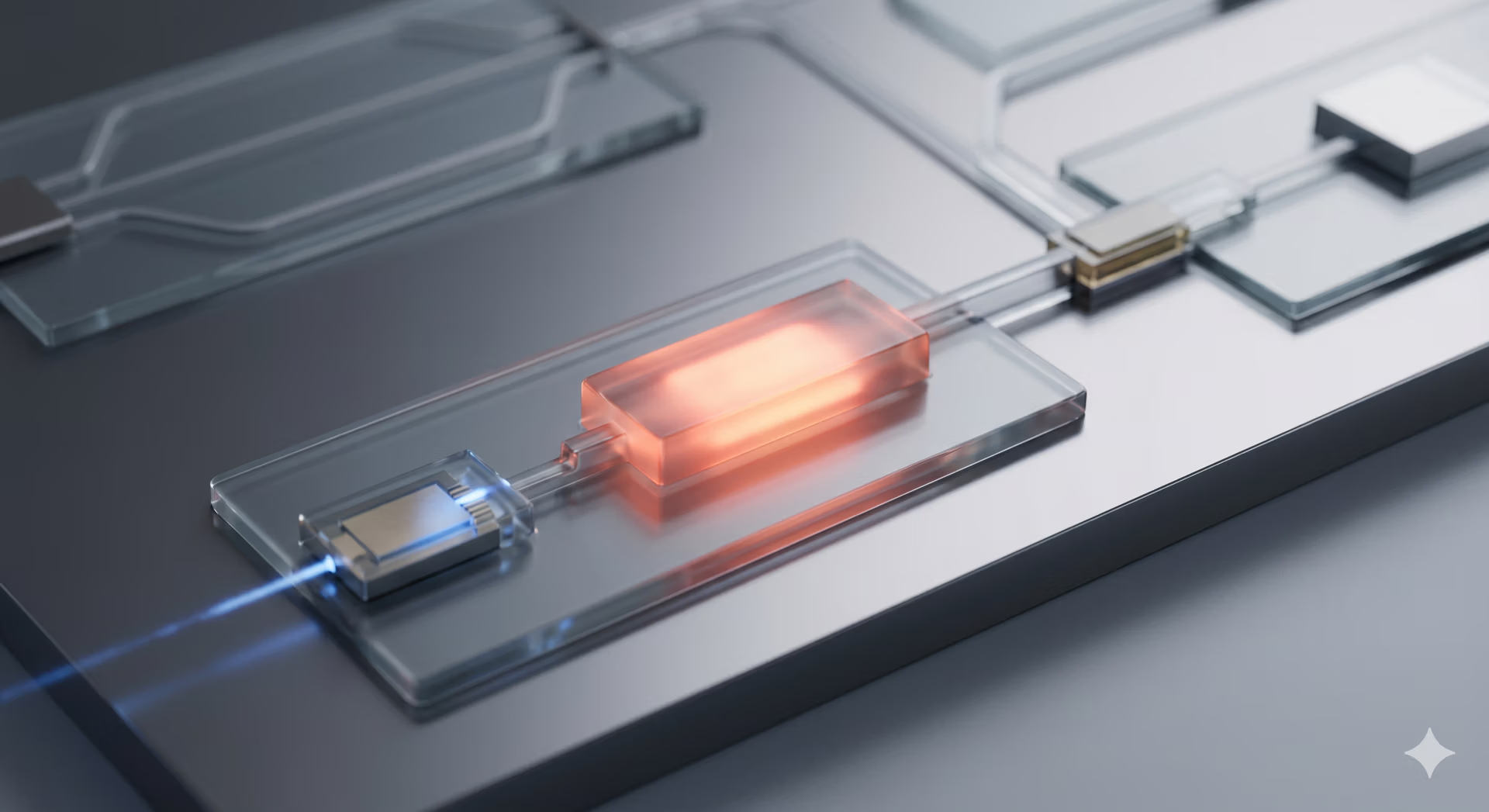
To eliminate the power consumed by driving electrical signals across printed circuit boards, the industry is moving toward Co-Packaged Optics (CPO). In CPO, the optical engine is moved off the edge of the board and packaged directly alongside the switch ASIC.
Because space is at an absolute premium on these tightly packed substrates, bulky amplifiers are out of the question. Semiconductor Optical Amplifiers (SOAs), due to their sub-millimeter footprint, are the only amplification technology that can be successfully integrated into silicon photonics (SiPh) CPO designs.
By utilizing arrays of Semiconductor Optical Amplifiers (SOAs) directly within the co-packaged module, engineers can offset the high insertion losses typical of silicon photonics modulators without adding the massive power overhead of electronic amplification.

3. Nanosecond Reaction Times for Bursty AI Traffic
Unlike traditional cloud computing traffic, which is relatively steady, generative AI workloads—such as deep learning parameter synchronization via InfiniBand or RoCEv2 networks—are notoriously “bursty.”
Massive amounts of data, often originating from semiconductor devices, are blasted across the network in microsecond intervals, followed by periods of relative silence, showcasing the unique demands of SOA (Service Oriented Architecture) in handling variable workloads. Optical components must be able to react to these sudden bursts instantly.
Traditional EDFAs suffer from long carrier lifetimes, meaning they take milliseconds to stabilize their gain when hit with sudden traffic spikes. Semiconductor Optical Amplifiers (SOA), on the other hand, boast extremely fast carrier dynamics.
SOAs can react, stabilize, and amplify optical bursts in nanoseconds. This ultrafast transient response ensures that AI data packets are not lost or corrupted during sudden transmission spikes, maintaining the integrity and speed of the AI training cluster.
4. Amplification as Preamplifiers at the Receiver end (ROSA)
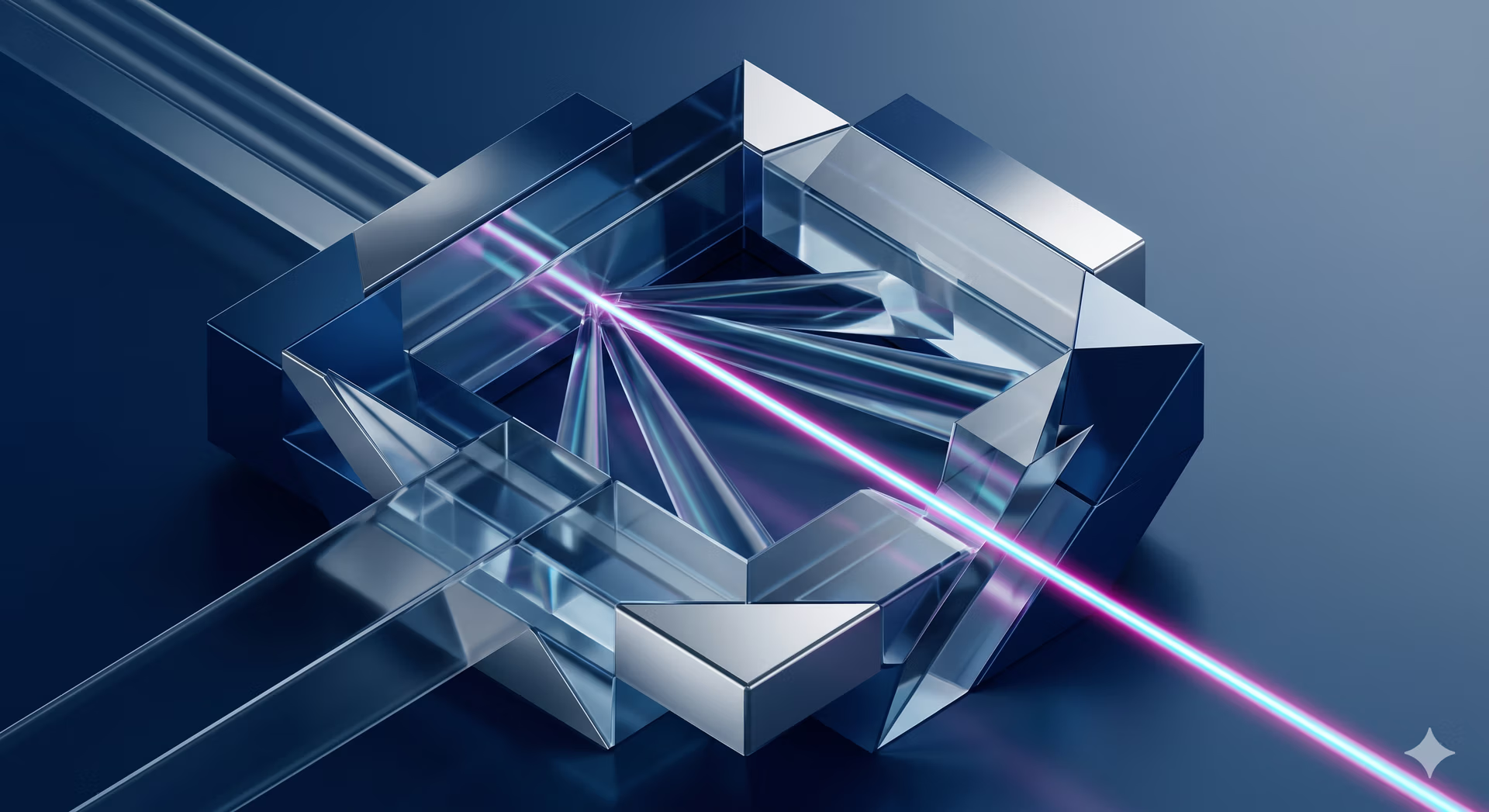
As interconnect speeds push toward 200G per lane and beyond, the sensitivity of photodetectors drops. To avoid turning up the power of the transmit lasers (which generates excess heat and shortens component lifespan), network designers use Semiconductor Optical Amplifiers (SOA) as preamplifiers inside the Receiver Optical Sub-Assembly (ROSA).
By placing SOAs right before the photodiode, the weak incoming optical signal is boosted, greatly improving the receiver’s signal-to-noise ratio and overall link margin without requiring power-hungry electronic equalization.
The Shift to the O-Band (131nm) and the Crucial Role of SOAs
For decades, long-haul telecommunications have relied on the C-band (155nm) because fiber optic cables exhibit the lowest attenuation at this wavelength. However, AI data centers are highly localized.
The connections between GPUs and top-of-rack switches are “short-reach,” typically spanning distances of 10 meters to 2 kilometers. Over these shorter distances, signal loss is less of a concern than chromatic dispersion—the phenomenon where different frequencies of light travel at slightly different speeds, causing the data pulses to blur together at high bit rates.
To combat chromatic dispersion at 800G and 1.6T speeds without using power-intensive DSPs, data centers are shifting their internal optical networks to the O-band (131nm), where standard single-mode fiber has a zero-dispersion point.
This shift presents a massive technological challenge: EDFAs, the standard amplifiers of the telecom world, physically cannot amplify light in the O-band, which requires advanced semiconductor solutions for effective implementation. While Praseodymium-Doped Fiber Amplifiers (PDFAs) exist for the O-band, they are incredibly large, expensive, and impractical for dense data center environments.
Therefore, O-band Semiconductor Optical Amplifiers are the absolute linchpin of modern AI networks. Without high-performance O-band Semiconductor Optical Amplifiers, the transition to low-dispersion, DSP-free, low-power short-reach interconnects would be physically impossible. SOAs are not just an alternative in this space; they are the only viable solution to amplify 131nm signals inside dense, high-speed optical transceivers.
Overcoming Historical SOA Challenges: Polarization and Nonlinearities
In the past, engineers were hesitant to deploy Semiconductor Optical Amplifiers due to concerns over Polarization-Dependent Gain (PDG) and nonlinear effects like Cross-Gain Modulation (XGM). Early SOAs would amplify light differently depending on its polarization state, causing unacceptable errors in high-speed networks.
Today, world-class photonics manufacturing has solved these issues with the use of SOA technology. Modern Semiconductor Optical Amplifiers are designed with advanced strained quantum-well and quantum-dot structures. These complex semiconductor architectures manipulate the bandgap and optical confinement to deliver virtually polarization-independent amplification.
Furthermore, modern SOAs, which often incorporate semiconductor technology, are engineered with high saturation output power, ensuring they can handle multiple wavelength channels simultaneously without suffering from signal-degrading crosstalk.
For AI data centers, this means Semiconductor Optical Amplifiers (SOA) now offer the perfect trifecta: the microscopic size needed for integration, the low power consumption needed to solve the energy bottleneck, and the rugged signal fidelity required for error-free 1.6T data transmission.
Inphenix: Your World-Class Partner for Semiconductor Optical Amplifiers
When integrating semiconductor components into high-stakes AI data center architectures, the quality, reliability, and precision of your SOA optical hardware cannot be compromised.
As a world-class laser and light source manufacturer, Inphenix stands at the forefront of optoelectronic innovation, offering industry-leading Semiconductor Optical Amplifiers (SOA) designed specifically to meet the rigorous demands of next-generation optical networks.
At Inphenix, we understand that off-the-shelf components rarely meet the bleeding-edge requirements of LPO, CPO, SOA, and advanced AI interconnects. That is why our Semiconductor Optical Amplifiers are engineered with distinct, market-leading advantages:
- Exceptional O-Band Performance: Inphenix specializes in high-gain, high-saturation 131nm SOAs perfectly tailored for the zero-dispersion environments of modern AI clusters.
- Ultra-Low Polarization Dependent Gain (PDG): Our proprietary strained quantum-well designs ensure that Inphenix SOAs deliver stable, uniform amplification regardless of the signal’s polarization state, guaranteeing high signal integrity.
- High Saturation Output Power: Inphenix Semiconductor Optical Amplifiers, often abbreviated as SOAs, are designed to handle high-density WDM traffic without distortion, maintaining pristine analog signal quality for DSP-free architectures.
- End-to-End Custom Fabrication: Operating our own ISO 9001-certified semiconductor fabrication facility allows us to offer completely customizable SOA solutions. Whether you need specific gain spectrums, custom packaging (butterfly, bare die, or integrated arrays), or unique waveguide designs for silicon photonics integration, Inphenix can design and manufacture it in-house.
- Proven Reliability: Built to Telcordia standards, our SOAs provide the rugged, long-term reliability required to operate continuously in the high-heat, high-stress environment of an AI data center.
By choosing Inphenix as your photonics partner, you are securing more than just a component; you are securing a competitive advantage in power efficiency, semiconductor integration, footprint reduction, and network speed with our advanced SOA technology.
Conclusion
The generative AI power bottleneck is a critical threat to the continued scaling of large language models and global data infrastructure. Continuing to rely on power-hungry electronic processing to move optical data is a dead end.
The future of data center interconnects is analog, integrated, and incredibly fast, with SOA technology playing a key role.
Semiconductor Optical Amplifiers (SOAs) are the foundational technology making this future possible. By enabling Linear Drive Pluggable Optics, facilitating Co-Packaged Optics, adapting to nanosecond burst traffic, and dominating the dispersion-free O-band, Semiconductor Optical Amplifiers are drastically lowering the picojoules-per-bit metric. They are freeing up crucial megawatts of power for the GPUs and proving that the path forward for AI is paved with advanced optical semiconductors.
To dominate the next era of high-speed networking, hardware designers must partner with manufacturers who deeply understand the physics, semiconductor technology, and fabrication of high-performance SOAs.
Ready to break through the power bottleneck in your next optical design?
Do not let your network speeds be throttled by inefficient, power-hungry components. Partner with a global leader in photonics manufacturing.
[Contact Inphenix today] to speak with our engineering team about our world-class Semiconductor Optical Amplifiers, request technical specifications, or discuss a custom optoelectronic solution tailored precisely to your application.
Let’s build the future of optical connectivity together.