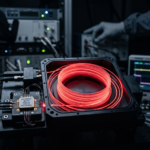
The digital age, as we know it, stands at the precipice of an unimaginable transformation. For decades, the relentless miniaturization of transistors has driven the exponential growth of computing power, a phenomenon known as Moore’s Law. Yet, as we approach the physical limits of silicon-based optoelectronic technology and explore materials like GaAs, along with advancements in optics, the quest for the next leap in computational capability leads us to a revolutionary frontier: quantum computing.
At the heart of this audacious endeavor, providing the very light and control mechanisms needed, are semiconductor lasers. INPHENIX, a world-class manufacturer of advanced light sources, is at the forefront of providing the critical semiconductor lasers and optoelectronic devices essential for unlocking the immense potential of next-gen computing.
The Looming Challenge: Beyond Classical Computing
Classical computers, no matter how powerful, fundamentally operate using bits that represent either a or a 1.
This binary system, while incredibly effective for current tasks, faces inherent limitations when tackling problems of immense complexity – from simulating molecular interactions for drug discovery to optimizing global logistics or breaking advanced encryption. The processing power required for these tasks scales exponentially, quickly outstripping the capabilities of even the most powerful supercomputers.
This is where next-gen computing, specifically quantum computing, steps in.
Instead of bits, quantum computers use “qubits” which can represent , 1, or both simultaneously through a phenomenon called superposition. Furthermore, qubits can be “entangled,” meaning their states are interconnected, even when physically separated. These quantum properties allow quantum computers to process vast amounts of information in parallel, offering the potential to solve problems intractable for classical machines.
However, realizing this potential is a monumental engineering challenge, particularly in terms of achieving the correct wavelength for quantum operations.
Qubits are fragile, susceptible to environmental noise, and require precise control and modulation, where GaAs (Gallium Arsenide) based devices, using stimulated emission, play a crucial role. Many leading quantum computing architectures rely on light – specifically, the ultra-precise and coherent light generated by semiconductor lasers through optical pumping – for their operation.
Semiconductor Lasers: The Light Behind Quantum Qubits
Semiconductor lasers are not just light sources; they are highly engineered devices capable of emitting light with specific wavelengths, narrow linewidths, and high stability. These characteristics are paramount for ensuring the reliability of interacting with and controlling qubits, which can take various forms:
- Trapped Ions: In ion trap quantum computers, individual ions are suspended in a vacuum using electromagnetic fields. Semiconductor lasers are used to cool these ions to near absolute zero, to entangle them, and to read out their quantum states. The precise wavelength and stability of the semiconductor lasers are critical to prevent unwanted energy transitions that could corrupt the fragile qubit information.
- Superconducting Qubits: While primarily controlled by microwave photons, advanced techniques for readout and future scaling may involve optical interconnections, where optoelectronic components and semiconductor lasers could play a role in connecting different quantum processors or for classical control.
- Neutral Atoms: Similar to trapped ions, neutral atoms require sophisticated semiconductor laser systems for trapping, cooling (e.g., using Doppler or Sisyphus cooling), entangling, and measuring their quantum states. The ability to finely tune the frequency of these semiconductor lasers is essential for addressing individual atoms.
- Photonic Qubits: Perhaps the most direct application, photonic quantum computers use photons themselves as qubits. Here, semiconductor lasers are the fundamental generators of these photons, often operating in regimes that produce single photons or entangled photon pairs. The purity, stability, and repetition rate of these semiconductor lasers are critical for building reliable photonic quantum circuits.
The demand for specialized semiconductor lasers for these diverse applications is immense.
They must be compact, energy-efficient, tunable, and robust – qualities that INPHENIX has perfected over years of manufacturing expertise. Their cutting-edge optoelectronic components ensure that the light delivered is exactly what quantum researchers need.
INPHENIX’s Role: Powering the Quantum Revolution with Optoelectronic Excellence
INPHENIX understands the stringent requirements of next-gen computing.
Their advanced semiconductor lasers, including GaAs materials, and related optoelectronic devices are engineered to meet the demanding specifications of quantum research and development.
- Superluminescent Diodes (SLDs): While not traditional lasers, INPHENIX’s SLDs provide broadband, high-power light. In quantum applications, particularly for metrology, spectroscopy, or as pump sources where optical pumping is required, the broadband nature and high spatial coherence of SLDs can be leveraged. For instance, in characterization of complex optoelectronic quantum circuits, SLDs can provide crucial measurement capabilities.
- Semiconductor Optical Amplifiers (SOAs): INPHENIX’s SOAs are vital for amplifying weak optical signals without conversion to electrical signals. In future quantum networks, where fragile quantum information encoded in photons needs to be transmitted over distances, SOAs could play a critical role in boosting signal strength while preserving quantum states. They are also crucial in classical optoelectronic control systems that interface with quantum processors.
- High-Power Semiconductor Lasers: For specific qubit manipulation (e.g., strong driving fields for atomic transitions), INPHENIX provides semiconductor lasers with the necessary power and spectral purity.
- DFB and DBR Lasers: For applications requiring extremely narrow linewidths and precise wavelength control, INPHENIX’s Distributed Feedback (DFB) and Distributed Bragg Reflector (DBR) semiconductor lasers operate based on the principle of stimulated emission and are invaluable. These precisely engineered semiconductor lasers are crucial for selectively addressing individual qubits in dense arrays or for achieving the coherence times necessary for quantum operations. Their stability ensures that the quantum state is not perturbed by laser noise.
The intersection of semiconductor lasers and quantum technology is rich with innovation.
Every advance in semiconductor laser technology – from improved stability and tunability to increased power efficiency, miniaturization, and the integration of GaAs materials, along with precise control over wavelength modulation – directly contributes to overcoming the hurdles in building practical quantum computers. This synergy underscores the critical role of advanced optoelectronic and optics manufacturing in propelling next-gen computing forward.
Beyond Quantum: Other Facets of Next-Gen Computing
While quantum computing garners significant attention, next-gen computing also encompasses other transformative areas where semiconductor lasers and optoelectronic devices are indispensable:
- Neuromorphic Computing: This field aims to build computers that mimic the human brain’s structure and function. Optical interconnects, powered by efficient semiconductor lasers, are being explored to overcome the bottleneck of electrical signaling, allowing for massive parallelism and high-speed data transfer between “neurons.”
- High-Performance Computing (HPC) & Data Centers: Even for classical computing, the demand for speed and energy efficiency is driving a shift towards optical interconnects within and between servers. Semiconductor lasers (VCSELs, DFB lasers) and other optoelectronic components are replacing electrical wires, offering vastly higher bandwidth, lower latency, and reduced power consumption for the massive data flows in modern data centers – the backbone of all digital services. This is a crucial step for achieving exascale computing and beyond.
- Optical Computing: A long-term vision involves computing directly with light, leveraging the properties of photons to perform operations. While still largely theoretical, developments in semiconductor lasers and integrated optoelectronic circuits are foundational to this ambitious goal.
- Artificial Intelligence (AI) Accelerators: Specialized hardware for AI, particularly for deep learning, often requires rapid data movement. Semiconductor lasers are becoming critical for high-bandwidth optical interconnects within these accelerators, helping to speed up complex neural network computations.
In all these areas, the precision, speed, reliability, and energy efficiency of semiconductor lasers make them the preferred choice over traditional electrical components.
The ability to manipulate light at these scales, enabled by sophisticated optoelectronic manufacturing, involves precise control over the wavelength and modulation, which is what defines the next generation of computational infrastructure.
The Road Ahead: Innovation and Collaboration
The journey to fully realize next-gen computing is long and complex, requiring continuous innovation in materials science, physics, engineering, and specifically, the development of GaAs technology.
The development of robust, scalable, and cost-effective semiconductor lasers, potentially utilizing GaAs, is a critical bottleneck that needs to be addressed. Researchers and engineers worldwide are working to improve the performance, reliability, and manufacturability of these devices.
Companies like INPHENIX are not just suppliers; they are active partners in this journey. By pushing the limits of optoelectronic design and manufacturing, they provide the enabling technologies that transform theoretical concepts into practical quantum and next-gen computing systems. Their expertise in creating semiconductor lasers with precise wavelength control, narrow linewidths, high power, and compact footprints is directly fueling the breakthroughs needed for tomorrow’s computers.
The future of computing is intrinsically linked to the future of light, with optics, optical pumping, and stimulated emission playing crucial roles in advancing new technologies. As we venture deeper into the quantum realm and push the boundaries of classical processing, semiconductor lasers will shine as the indispensable light source, illuminating the path to unparalleled computational power.
The synergy between advanced optoelectronic manufacturing and the groundbreaking research in next-gen computing promises a technological revolution that will reshape industries, expand scientific understanding, and empower humanity with unprecedented capabilities.
As the world accelerates toward a future defined by unprecedented computational power, the role of semiconductor lasers continues to expand, touching every facet of next-generation computing. Their influence is not confined to the quantum realm alone; these advanced light sources are rapidly becoming the backbone of a new era in information technology, where speed, precision, and scalability are paramount.
The Science Behind Semiconductor Lasers
At their core, semiconductor lasers operate on the principle of stimulated emission, where electrons and holes recombine in a semiconductor material—often gallium arsenide (GaAs) or indium phosphide (InP)—to emit photons of a specific wavelength. The ability to engineer these materials at the nanoscale enables the creation of lasers with highly tailored properties: single-mode operation, ultra-narrow linewidths, and exceptional wavelength stability. These characteristics are essential for applications ranging from quantum computing to high-speed optical communications.
Recent advances in material science have led to the development of quantum well and quantum dot lasers, which offer even greater control over emission properties. These innovations are paving the way for more efficient, compact, and versatile semiconductor lasers, capable of meeting the stringent demands of next-gen computing systems.
Enabling Optical Interconnects and Data Transmission
One of the most transformative applications of semiconductor lasers lies in optical interconnects. As data centers and supercomputers grapple with ever-increasing data volumes, traditional copper-based electrical connections are reaching their physical and economic limits. Optical interconnects, powered by vertical-cavity surface-emitting lasers (VCSELs) and distributed feedback (DFB) lasers, offer a solution by transmitting data at the speed of light with minimal loss and interference.
This shift to optical communication is not just about speed—it is also about energy efficiency. Semiconductor lasers consume significantly less power than their electrical counterparts, reducing the carbon footprint of massive data centers and supporting the global push toward sustainable technology infrastructure.
Pioneering Photonic Integration
The integration of semiconductor lasers with other photonic components on a single chip—known as photonic integrated circuits (PICs)—is revolutionizing the design of computing hardware. PICs enable the miniaturization of complex optical systems, making them more robust, scalable, and cost-effective. This integration is critical for the development of compact quantum processors, neuromorphic chips, and AI accelerators, where space and power constraints are ever-present.
Moreover, advances in silicon photonics are allowing semiconductor lasers to be seamlessly integrated with existing silicon-based electronics. This hybrid approach leverages the maturity of silicon manufacturing while harnessing the unique advantages of optical technologies, opening new avenues for innovation in both classical and quantum computing.
Driving Innovation in Sensing and Metrology
Beyond computing, semiconductor lasers are indispensable in precision sensing and metrology. Their ability to produce coherent, stable light at specific wavelengths makes them ideal for applications such as atomic clocks, gravitational wave detection, and high-resolution spectroscopy. In quantum computing laboratories, these lasers are used to calibrate and stabilize experimental setups, ensuring the accuracy and reproducibility of groundbreaking research.
The Future: Toward Universal Quantum Networks
Looking ahead, the vision of a universal quantum internet—where quantum information is transmitted securely across global distances—relies heavily on the continued advancement of semiconductor laser technology. Quantum key distribution (QKD), entanglement swapping, and quantum repeaters all depend on reliable, high-performance lasers to generate and manipulate the delicate quantum states of light.
Semiconductor lasers are more than just components—they are the enablers of a technological revolution. As quantum computing, AI, and optical communications converge, the demand for precision-engineered, reliable, and scalable light sources will only intensify. By investing in advanced semiconductor laser technology today, innovators and organizations are laying the foundation for a smarter, faster, and more connected tomorrow.
INPHENIX and other industry leaders are investing heavily in research and development to push the boundaries of what semiconductor lasers can achieve. From improving coherence times and reducing noise to enabling new wavelengths and integration methods, the next decade promises a wave of innovation that will redefine the landscape of computing and communications.
Illuminate Your Future with INPHENIX
Ready to harness the power of light for your next-gen computing innovations?
From quantum research to advanced AI accelerators and high-speed data solutions, INPHENIX provides the world-class semiconductor lasers and optoelectronic components you need to build the future. Our unparalleled precision, reliability, and custom solutions are designed to meet the most demanding specifications.
Contact INPHENIX today to discuss your project requirements and discover how our cutting-edge light sources can unlock the full potential of your next-generation computing advancements. Partner with us, and together, we will build the future of computation!