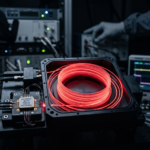
The rapid evolution of modern transportation and technology has thrust photonics into the center of the automotive engineering universe. Driven by the scaling of autonomous driving and stringent safety mandates—such as Euro NCAP guidelines—automotive LiDAR and solid-state sensing for ADAS are major traffic drivers across research and development hubs in the US and Europe. Traditional mechanical scanning systems are rapidly being phased out in favor of resilient, high-precision solid-state architectures. This shift requires sophisticated light engines, including high-power semiconductor optical sources, tunable components, and robust optical amplification modules. Industry pioneers like Inphenix deliver advanced photonic components that directly support these demanding requirements, helping system integrators build reliable, long-range environmental perception architectures.
The Regulatory and Market Push: Why ADAS and Automotive LiDAR are Accelerating
The integration of advanced driver-assistance systems (ADAS) has transitioned from a luxury market differentiator to a baseline requirement for modern vehicle safety ratings. Regulatory frameworks, most notably the European New Car Assessment Programme (Euro NCAP), have instituted rigorous benchmarks for pedestrian detection, autonomous emergency braking (AEB), and blind-spot monitoring. To achieve these high safety scores under complex driving scenarios, vehicle brains require multi-modal sensory inputs, including object detection technologies such as lidar, where cameras and radar alone fall short.
Radar offers exceptional velocity tracking and weather penetration, but it struggles with high-resolution spatial mapping. Cameras provide rich visual context, yet they falter under adverse lighting conditions, severe glare, or heavy precipitation. Automotive LiDAR bridges this performance gap by emitting precise laser pulses for distance measurement to map physical environments in 3D with millimeter-level accuracy, using 3D imaging to create detailed point clouds for spatial analysis through advanced object detection capabilities. As Level 2+ and Level 3 self-driving autonomous features become standard across consumer vehicles in North America and Europe, the demand for affordable, highly reliable automotive LiDAR hardware has skyrocketed.
For automotive tier-1 suppliers and OEMs, the core engineering challenge lies in scaling production without sacrificing performance or operational lifespan. Environmental stressors—ranging from extreme desert heat to sub-zero winter conditions—demand ruggedized optical packages that can withstand the challenges of lidar systems. Manufacturers look toward vertically integrated photonics creators like Inphenix to supply core technological building blocks, including high-grade Superluminescent Diodes and robust Semiconductor Optical Amplifiers capable of maintaining peak emission integrity under harsh vehicular stress.
Transitioning from Mechanical to Solid-State Architectures
Early-generation commercial lidar setups relied heavily on mechanical spinning mirrors to steer light beams across a 360-degree field of view. While effective for initial proof-of-concept robotaxis, these macroscopic moving parts introduce mechanical wear points, high power consumption, and bulky form factors that clash with sleek automotive styling guidelines.
The modern paradigm focuses entirely on solid-state automotive LiDAR systems. By eliminating physical moving parts, manufacturers can embed compact sensors seamlessly into headlamps, bumpers, or roof modules. Solid-state configurations generally fall into two primary categories: Flash LiDAR and optical phased arrays (OPAs).
- Flash LiDAR: Illuminates the entire target scene instantaneously with a single, broad laser flash, capturing a comprehensive 3D frame instantly. This approach requires high peak-power optical sources and sensitive detector arrays.
- Optical Phased Arrays (OPAs): Utilizes constructive and destructive interference to electronically steer a solid-state laser beam without any physical movement, offering rapid, programmable gaze control, which is crucial for applications like lidar systems.
Implementing these solid-state designs safely and economically with lidar requires precise control over the optical spectrum. Engineers frequently rely on high-stability light sources, sophisticated software, and advanced Swept Light Sources to drive frequency-modulated continuous-wave (FMCW) systems, ensuring clear separation between ambient noise and returned signals.
FMCW vs. Time-of-Flight: The Laser Technology Battleground
Within the engineering corridors of Detroit, Stuttgart, and Munich, a quiet technical debate shapes the future of sensor selection: Time-of-Flight (ToF) versus Frequency Modulated Continuous Wave (FMCW) detection, with lidar technology playing a crucial role in both approaches.
Traditional ToF systems calculate distance by measuring the precise time elapsed between emitting a short laser pulse and detecting its reflection, leveraging technology to enhance accuracy. While conceptually straightforward, ToF systems operating in the near-infrared spectrum can face interference from direct sunlight or competing vehicle LiDAR systems. Furthermore, maximizing range requires increasing pulse energy, which is strictly bounded by human-eye safety regulations (typically centered around 905nm or shifting toward safer 155nm wavelengths).
Enter FMCW, a coherent detection technique that uses lidar to emit a continuous laser beam whose frequency is modulated over time (typically linearly chirped). By mixing the returned signal with a local oscillator reference beam, the system extracts precise distance and instantaneous velocity (Doppler shift) simultaneously.
- Immunity to Interference: FMCW systems are inherently immune to ambient sunlight and cross-talk from other vehicles, as they only detect lidar signals matching the exact frequency chirp profile.
- Extended Range at Eye-Safe Wavelengths: By shifting to 155nm light sources, FMCW lidar systems can pump higher optical power into the environment while remaining completely safe for human eyes, unlocking long-range detection distances exceeding 250 meters.
Developing reliable FMCW platforms with lidar technology places intense demands on component-level engineering. To maintain coherence over long optical paths, developers utilize advanced Narrow Linewidth Lasers and specialized gain mediums. Inphenix provides custom-engineered Gain Chips and Fabry Perot Lasers that allow optical designers to tailor their coherence length and output profiles to meet strict automotive constraints.
Regional Trends: US Versus Europe Deployment Strategies
While both North American and European automotive markets share a common goal of deploying safer autonomous systems, their implementation roadmaps display distinct regional nuances.
United States: Commercial Autonomy and High-Speed Validation
In the US, development traffic is heavily concentrated around commercial robotaxi fleets, long-haul trucking automation, and high-speed highway ADAS, with self-driving lidar technology playing a pivotal role in these advancements. Regulatory frameworks lean toward state-level performance monitoring coupled with federal oversight from the National Highway Traffic Safety Administration (NHTSA).
US-based engineers prioritize ultra-long-range detection capabilities using lidar (200m+) to give autonomous heavy trucks and delivery vehicles sufficient stopping distance at highway speeds. This creates massive demand for 155nm solid-state architectures and advanced signal processing modules. Companies scaling these platforms often partner with trusted photonics innovators to source reliable Broadband Light Sources for calibration and testing benches during the manufacturing phase.
Europe: Stringent Euro NCAP Mandates and In-Cabin Synergy
European automotive development is deeply intertwined with strict consumer safety ratings administered by Euro NCAP, alongside aggressive European Union targets for zero-emission and ultra-safe urban mobility, including advancements in 3d imaging technologies. European Tier-1 suppliers focus heavily on robust sensor fusion—integrating automotive LiDAR and object detection seamlessly with high-definition cameras and automotive-grade radar to protect vulnerable road users (VRUs) like cyclists and pedestrians in dense urban European cityscapes.
Additionally, European manufacturers place a heavy emphasis on thermal stability and component lifespan. Because vehicles must endure extreme temperature fluctuations from Alpine winters to Mediterranean summers, every optical component inside the LiDAR module must be Telcordia-compliant or built to equivalent automotive qualification standards. High-reliability Distributed Feedback (DFB) Lasers from Inphenix are frequently deployed in these mission-critical optical links, providing stable single-frequency operation regardless of environmental thermal shifts.
Overcoming Engineering Challenges in Automotive Photonics
Designing optical sensors, such as lidar, for mass-market vehicles introduces hurdles that do not exist in telecommunications or laboratory environments. Engineers must balance four competing parameters: cost, size, reliability, and performance.
1. Thermal Management
Semiconductor lasers and optical amplifiers are inherently sensitive to temperature changes. Shifts in junction temperature can cause wavelength drift, degrading the sensitivity of coherent FMCW systems. Packaging designs for lidar systems must incorporate micro-thermoelectric coolers (TECs) and passive thermal dissipation pathways without inflating the module footprint.
2. Cost Reduction at Scale
To achieve widespread adoption across consumer-tier vehicles, automotive LiDAR sensors must drop below specific cost thresholds per unit. This economic reality drives the shift toward silicon photonics and integrated photonic integrated circuits (PICs), where optical paths are etched directly onto a semiconductor substrate. Inphenix supports this transition by offering flexible Customization & Foundry Services to help manufacturers transition from discrete optical benches to compact, scalable photonic layouts.
3. Environmental Durability
Automotive sensors endure continuous mechanical vibration, shock from potholes, moisture intrusion, and exposure to road salt. Light sources and detectors must be hermetically sealed and rigorously tested. Utilizing proven packaging techniques ensures that optical alignment in lidar systems remains locked over a 10-to-15-year vehicle operational lifecycle.
The Future of Laser Sensing in Next-Generation Mobility
As vehicle architectures migrate toward centralized zonal electronic/electrical (E/E) architectures, the role of optical sensing, including self-driving capabilities, will expand beyond simple exterior navigation. Future vehicle platforms are slated to incorporate interior cabin monitoring using eye-safe infrared lasers to track driver attentiveness, alongside exterior surround-view automotive LiDAR nodes that feed real-time semantic maps to cloud-connected traffic management networks.
The convergence of high-performance ADAS mandates and mature solid-state laser technology marks the transition of LiDAR from an experimental research tool into an indispensable automotive safety standard. By leveraging advanced optical components—such as high-power semiconductor amplifiers, ultra-stable laser diodes, and precision-engineered light sources from dedicated photonics partners like Inphenix—system architects are successfully solving the complex engineering equations of modern mobility.
As manufacturing yields improve and component costs decline over the coming years, automotive LiDAR and solid-state sensing will cement their place as the visual backbone of autonomous transportation across the US, Europe, and beyond.