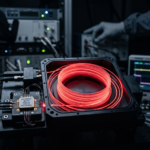
Modern industrial and energy systems demand unprecedented levels of safety, production efficiency, real-time monitoring, strategy, and collaboration within the community and space. Traditional point sensors often fall short when tracking large-scale or hazardous assets spanning hundreds of kilometers. To bridge this critical visibility gap, DFOS has emerged as the definitive diagnostic standard. By transforming a standard fiber optic cable into a continuous array of thousands of virtual sensors, DFOS unlocks continuous monitoring capabilities previously thought impossible.
Asset managers, civil engineers, and energy operators increasingly rely on DFOS and AI technologies to safeguard critical infrastructure, detect structural anomalies early, and optimize operational output. Implementing robust Distributed Fiber Optic Sensing networks requires advanced photonic components, high-performance light sources, and precise data interrogation units. Advanced optoelectronic manufacturers like Inphenix play a foundational role in providing the specialized optical engines that power these measurement setups.
The Core Technology Behind Distributed Fiber Optic Sensing
At its architectural heart, Distributed Fiber Optic Sensing leverages the physical properties of light traveling through an optical fiber. When a laser pulse propagates down a fiber strand, light interacts with the glass molecular matrix, scattering back along the path. By analyzing this backscattered light through detailed analysis, monitoring systems extract precise profiles of temperature, strain, and acoustic vibrations across the entire length of the cable.
The primary scattering phenomena harnessed in modern DFOS architectures include:
- Rayleigh Scattering: Highly sensitive to micro-bending and local acoustic vibrations, powering Distributed Acoustic Sensing (DAS).
- Brillouin Scattering: Temperature and strain-dependent frequency shifts, utilized for Distributed Temperature and Strain Sensing (DTSS).
- Raman Scattering: Temperature-dependent intensity changes, providing high-resolution Distributed Temperature Sensing (DTS).
Because a single fiber cable functions as a continuous sensing medium, DFOS eliminates the blind spots inherent in discrete sensor layouts. Engineers deploy DFOS architectures to measure parameters down to millimeter spatial resolutions over tens or even hundreds of kilometers without active electrical components in the field.
Key Photonic Components Powering High-Performance DFOS Systems
The reliability and accuracy of any DFOS network depend heavily on the quality of the optical light source and signal amplification hardware integrated into the interrogator unit. High-coherence lasers, broadband components, and optical amplifiers dictate the dynamic range, signal-to-noise ratio, and maximum sensing distance.
Broadband Light Sources and Superluminescent Diodes (SLDs)
For high-precision interferometric and optical coherence-based Distributed Fiber Optic Sensing systems, ultra-wideband illumination is essential. Engineers often incorporate advanced Superluminescent Diodes (SLDs) to provide low-coherence, high-power output that minimizes noise and enhances spatial resolution. These components are specifically designed to operate reliably across harsh industrial environments.
Swept Wavelength Light Sources
Frequency-modulated continuous-wave (FMCW) and optical frequency domain reflectometry (OFDR) approaches require exceptional tuning linearity and long coherence lengths. High-speed Swept Light Sources enable rapid scan rates and precise wavelength sweeps, directly boosting the data acquisition speed of real-time DFOS platforms.
Signal Amplification with Semiconductor Optical Amplifiers (SOAs)
As monitoring distances scale up in long-haul energy pipelines or subsea cables, optical signal attenuation becomes a major bottleneck. Integrating high-gain, low-noise Semiconductor Optical Amplifiers (SOAs) into the interrogator architecture ensures that weak backscattered signals are efficiently boosted without introducing prohibitive degradation or distortion.
Application of DFOS in the Energy Sector
The global energy transition requires unprecedented oversight of traditional fossil fuel assets and modern renewable installations alike, with AI playing a crucial role in enhancing efficiency and prediction. DFOS provides the backbone for intelligent energy grids and resilient asset management.
Oil and Gas Pipeline Monitoring
Pipelines traverse thousands of miles of unpredictable terrain, facing threats from ground movement, third-party excavation, and structural corrosion. Implementing a continuous DFOS setup allows operators to monitor acoustic vibrations and thermal anomalies simultaneously. If a leak occurs, the localized temperature drop or high-frequency acoustic signature is instantly localized by the DFOS interrogator. This real-time visibility prevents environmental disasters and reduces costly maintenance response times.
Subsea Power Cables and Offshore Wind Farms
Offshore wind farms and subsea inter-array cables operate in intensely demanding marine environments. Mechanical fatigue caused by wave action and seabed shifting can jeopardize power transmission. Operators use specialized Distributed Fiber Optic Sensing cables integrated directly into the power umbilical. This continuous structural health monitoring detects excessive bending, anchor dragging incidents, and thermal overloads long before catastrophic failure occurs.
Geothermal Energy Exploration
Geothermal systems subject materials to extreme temperatures and corrosive chemical exposure. Specialized high-temperature DFOS deployments provide real-time thermal profiling down deep production wells, helping engineers optimize steam extraction rates and protect downhole casing integrity.
Civil Infrastructure Monitoring Through DFOS
Civil infrastructure—including bridges, tunnels, dams, and rail networks—ages continuously under the pressure of heavy dynamic loads, environmental stressors, and the constraints of limited space. Integrating DFOS during construction or retrofitting existing assets shifts maintenance strategies from reactive repairs to predictive optimization.
Bridge and Overpass Structural Health Monitoring
Bridges endure constant cyclic loading from vehicular traffic and thermal expansion stresses. By embedding or surface-mounting fiber optic cables along key structural girders, DFOS tracks strain distribution across the entire span. Engineers analyze these continuous strain profiles to identify localized micro-cracks or structural fatigue shifts that discrete strain gauges would easily miss.
Tunnel Convergence and Ground Movement Tracking
Tunnel excavation and underground transit construction inherently disturb surrounding geological strata. Deploying a comprehensive DFOS network around the concrete lining provides immediate alerts regarding ground settlement, rock shifting, or convergence pressures. The real-time data supplied by DFOS protects workers during construction and ensures long-term operational safety for subterranean rail and highway links.
Dam and Levee Seepage Detection
Embankment dams and levees face continuous threats from internal erosion and piping caused by subsurface water movement. Thermal-based Distributed Fiber Optic Sensing utilizes the thermal contrast between ambient seepage water and the surrounding dam body. When water flows through an unpredicted seepage path, the localized temperature profile shifts, allowing DFOS to pinpoint the exact leakage coordinates immediately.
Advantages of DFOS Over Traditional Monitoring Technologies
While traditional monitoring options like electrical strain gauges, thermocouples, and point accelerometers have served industry for decades, they suffer from severe scalability bottlenecks. DFOS transforms structural sensing by offering distinct operational benefits to the community.
- Complete Spatial Coverage: Traditional sensors provide data only at discrete points, leaving massive gaps between measurement nodes. DFOS creates a continuous sensing matrix across 100% of the fiber length.
- Immunity to Electromagnetic Interference (EMI): Because optical fibers transmit light rather than electrical currents, DFOS systems are entirely immune to lightning strikes, high-voltage power lines, and heavy industrial EMI.
- Intrinsically Safe in Hazardous Zones: Optical fibers carry no electrical voltage, making DFOS safe for deployment in explosive atmospheres, flammable fuel depots, and high-voltage substations without explosion-proof conduit requirements.
- Reduced Cabling and Weight Complexity: Instead of running heavy copper wiring harnesses for thousands of individual sensors, a single hair-thin fiber optic strand handles massive data payloads over extreme distances.
Customization and Optoelectronic Integration for Demanding Deployments
Deploying reliable DFOS systems in extreme environments requires specialized engineering and robust component packaging. Standard off-the-shelf optics frequently fail when subjected to severe thermal cycling, deep-sea pressures, or intense mechanical shock. Tailored optoelectronic integration is therefore vital for long-term field survivability.
Engineers seeking specialized configurations often utilize comprehensive Customization & Foundry Services to design custom Indium Phosphide (InP) and Gallium Arsenide (GaAs) active chips, specialized facet coatings, and advanced thermal packaging. Precision wafer fabrication, custom anti-reflective (AR) coatings, and hermetic butterfly packaging ensure that the optical engines driving DFOS interrogators maintain peak performance over decades of continuous operation.
Furthermore, rigorous environmental screening and spectral testing guarantee that every active component within the Distributed Fiber Optic Sensing chain meets stringent reliability benchmarks required by aerospace, defense, and heavy industrial sectors.
Future Trajectories and Evolving Capabilities of DFOS
As photonics technology matures, the capabilities of DFOS in space and terrestrial applications continue to expand at a rapid pace. Researchers and developers are pushing the boundaries of spatial resolution, measurement speed, and processing intelligence.
Artificial Intelligence and Machine Learning Integration
Modern DFOS networks generate massive streams of continuous acoustic, thermal, and strain data, often requiring the assistance of AI to efficiently manage and analyze this data. Processing this volume of information manually is impractical. Integrating Artificial Intelligence and Machine Learning algorithms directly into Distributed Fiber Optic Sensing software suites allows systems to autonomously categorize specific disturbance signatures—differentiating between harmless environmental noise, such as heavy rain or wind, and genuine threats, like unauthorized digging or structural rupture.
Extended Range and Enhanced Spatial Resolution
Advances in coherent detection techniques and ultra-low-loss fiber manufacturing are steadily increasing the operational range of single-ended DFOS setups. Concurrently, improvements in advanced Broadband Light Sources allow for millimeter-scale spatial resolution, enabling engineers to inspect micro-defects in composite materials and delicate electronic housings.
The transition toward fully autonomous, resilient infrastructure and sustainable energy production depends heavily on real-time, comprehensive data visibility. By turning physical assets into intelligent, self-monitoring structures, DFOS provides the foundational clarity required to manage complex engineering challenges safely and efficiently into the future.
Conclusion
The widespread adoption of Distributed Fiber Optic Sensing marks a paradigm shift in how engineers develop strategy, monitor, protect, and maintain critical infrastructure and energy assets within the community. By turning miles of standard glass fiber into dense matrices of real-time diagnostic points, DFOS removes long-standing operational blind spots, replacing reactive maintenance cycles with predictive safety frameworks.
Sustaining the rapid evolution of these measurement networks relies heavily on breakthrough advancements in optoelectronic engineering. From ultra-wideband light sources and high-gain amplification to tailored semiconductor manufacturing, component innovators like Inphenix supply the fundamental hardware required to push physical boundaries further.As intelligent machine learning frameworks converge with advanced photonics, Distributed Fiber Optic Sensing will continue to anchor the safety, resilience, and operational efficiency of global infrastructure for generations to come.