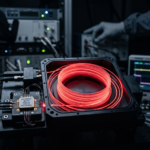
In our hyper-connected world, information flows ceaselessly – from the mundane exchange of messages on our smartphones to the colossal data streams powering global financial markets and scientific research. Yet, the unsung hero enabling this pervasive connectivity, often operating silently behind the scenes, is optical communications.
This revolutionary technology, harnessing the power of light, has fundamentally reshaped how we transmit data, influencing everything from the micro-architecture of a data center to humanity’s most ambitious voyages into deep space. At the core of this transformation are advanced light sources, photonics, and optoelectronic components, with world-class manufacturers like INPHENIX providing the critical building blocks that drive this unseen influence.
The Foundation: What is Optical Communications?
At its heart, optical communications involves transmitting information by sending pulses of light through an optical fiber or free space.
Unlike traditional electrical signals, which suffer from resistance, interference, and limited bandwidth over distance, light waves can carry vast amounts of data at incredibly high speeds with minimal loss.
This makes optical communications the backbone of the internet, telecommunications, and countless other data-intensive applications.
Key Components of Optical Communications Systems
- A Light Source: Typically a semiconductor laser or LED, responsible for converting electrical signals into light pulses. The quality, stability, and speed of this source are paramount.
- An Optical Medium: Primarily fiber optic cables and waveguides for terrestrial and undersea links, or free space for satellite and short-range wireless optical communications.
- A Detector: A photodiode that converts the light pulses back into electrical signals at the receiving end, acting as the receiver in the system.
- Amplifiers and Repeaters: Devices like INPHENIX’s Semiconductor Optical Amplifiers (SOAs) that boost the light signal over long distances without needing to convert it back to electrical form, thus preserving data integrity and speed.
The evolution of these components, particularly the light sources and amplifiers, has been a driving force behind the exponential growth of data capacity and reach.
Data Centers: The Pulse of the Digital Economy
Modern data centers are the nerve centers of the digital world, housing the servers, storage, and networking equipment that power cloud computing, AI, streaming services, and countless applications.
The sheer volume of data being processed and moved within a single data center is staggering, often measured in terabits per second.
This internal traffic, known as “east-west” traffic, far exceeds external internet traffic.
Challenges with Traditional Electrical Interconnects
Traditional electrical interconnects within a data center face severe limitations:
- Bandwidth Bottleneck: Copper cables struggle to provide the necessary bandwidth for interconnected servers and switches.
- Power Consumption: Electrical signals generate significant heat and require considerable power, leading to massive operational costs for cooling.
- Latency: The speed of electrical signals can introduce delays, impacting the performance of real-time applications.
This is where optical communications becomes indispensable.
Fiber optic cables and optoelectronic transceivers are rapidly replacing copper within the data center. Vertical Cavity Surface Emitting Lasers (VCSELs) and Distributed Feedback (DFB) semiconductor lasers are the workhorses here, transmitting data at speeds of 10Gbps, 25Gbps, 100Gbps, 400Gbps, and even 800Gbps over short distances.
These semiconductor lasers are compact, energy-efficient, and capable of high-speed modulation, making them ideal for the dense, high-performance environments of a data center.
INPHENIX plays a crucial role in enabling this internal data center revolution.
While not directly manufacturing VCSELs for consumer-grade transceivers, their expertise in semiconductor laser technology and optoelectronic components underpins the fundamental understanding and development of the light sources that drive these systems. Moreover, INPHENIX’s Superluminescent Diodes (SLDs) are invaluable in the advanced testing and characterization of data center optical communications equipment.
Their broad spectral output and high power can be used for component testing, fiber inspection, and performance monitoring, ensuring the reliability and integrity of the complex optoelectronic networks within a data center.
Every high-speed link in a data center silently relies on the precision engineering that INPHENIX champions.
Beyond Terrestrial: Optical Communications in Deep Space
The influence of photonics and optical communications extends far beyond the Earth’s atmosphere, reaching into the vast emptiness of deep space.
For decades, space missions have relied on radio frequency (RF) communications to send commands to spacecraft and receive scientific data back to the receiver.
While reliable, RF has inherent limitations in bandwidth, especially over interplanetary distances. As missions become more ambitious, requiring higher resolution imagery, more complex scientific data, and even streaming video from Mars, the need for increased bandwidth becomes critical.
The Role of Laser Communications
This is where “laser communications” or “free-space optical communications” for space comes in.
By using semiconductor lasers and incorporating waveguide technology to transmit data, missions can achieve vastly higher data rates than traditional RF systems. The narrower beam of a laser can pack more information into a signal and requires less power to transmit over vast distances, because its energy is highly concentrated.
NASA’s Lunar Laser Communications Demonstration (LLCD) in 2013, and more recently, the Laser Communications Relay Demonstration (LCRD) and the TeraByte InfraRed Delivery (TBIRD) system, have successfully demonstrated record-breaking data rates (e.g., 200 gigabits per second for TBIRD) from space to Earth.
These advancements are paving the way for future deep space missions to transmit unprecedented volumes of scientific data, enabling breakthroughs in our understanding of the universe.
Challenges for Space-Based Optical Communications
The challenges for space-based optical communications are immense:
- Precise Pointing: Aiming a narrow laser beam at a small detector millions of kilometers away requires extreme precision.
- Atmospheric Turbulence: Earth’s atmosphere can distort laser signals, necessitating adaptive optics.
- Extreme Environments: Spacecraft components, including semiconductor lasers and optoelectronic detectors, must withstand radiation, extreme temperatures, and vacuum.
INPHENIX’s expertise in rugged, high-performance semiconductor lasers and optoelectronic components is critical here.
While they might not be supplying components directly to every space mission, their foundational research and development into highly reliable and stable light sources contribute significantly to the technology that eventually makes it into space-qualified systems.
The very principles of reliable optical communications in harsh environments are perfected in labs using advanced semiconductor laser technologies, often from leaders like INPHENIX. Specifically, INPHENIX’s Semiconductor Optical Amplifiers (SOAs), potentially integrated with advanced waveguide technology, could be adapted for future deep space applications to boost weak optical signals received by the receiver from distant probes, extending the range and reliability of inter-satellite or deep space-to-Earth links. Their SLDs can also be crucial for precise alignment and calibration of complex optical systems in demanding space environments.
The Enabling Technologies: INPHENIX’s Contribution
The influence of optical communications is unseen because the underlying technology works so efficiently.
This efficiency is a direct result of continuous innovation in semiconductor laser and optoelectronic design. INPHENIX’s commitment to cutting-edge research and manufacturing excellence ensures that the foundational components are available to push these boundaries.
- Semiconductor Optical Amplifiers (SOAs): Crucial for long-haul terrestrial and subsea fiber optic networks, SOAs amplify light signals directly without converting them back into electrical signals. This preserves signal integrity, reduces latency, and extends transmission distances, making the internet as we know it possible. In a data center, SOAs could be vital for future long-reach interconnects between different campus buildings.
- Superluminescent Diodes (SLDs): These are broad-spectrum, high-power light sources. Beyond data center testing, SLDs are used in various sensing and metrology applications where precise optical measurement is needed, which could include the calibration and alignment of optical communications systems, both terrestrial and spatial.
- High-Performance Lasers: INPHENIX’s broader range of semiconductor lasers provides the stable, high-power, and precisely tuned light required for diverse optical communications applications, from quantum key distribution (QKD) terrestrial links to advanced scientific instrumentation that supports the development of space-borne optical communications.
The Unstoppable March of Light
From the flickering packets of information racing through a high-density data center to the faint whispers of data traversing millions of kilometers from a probe exploring the outer solar system, optical communications is the silent, powerful engine driving our information age.
Its unseen influence is growing exponentially, promising ever-faster data, more efficient networks, and unprecedented capabilities for scientific discovery and global connectivity.
As the demand for bandwidth continues to soar, and humanity’s aspirations reach further into the cosmos, the role of advanced semiconductor lasers and optoelectronic components will only become more critical. Companies like INPHENIX, by continuously innovating at the fundamental level of light generation and manipulation, are not just participants; they are vital enablers, illuminating the pathways for the future of communication, from the densest digital hubs to the final frontier.
The future of data is light, and that future is being built today.
Empower Your Data’s Future with INPHENIX
Are you pushing the boundaries of optical communications in your data center projects, advanced networking solutions, or even aerospace applications?
Discover how INPHENIX’s world-class Semiconductor Optical Amplifiers (SOAs), Superluminescent Diodes (SLDs), and custom semiconductor laser solutions can provide the unparalleled performance and reliability you need.
Contact INPHENIX today to leverage our cutting-edge optoelectronic expertise and accelerate your innovations in data transmission, from Earth’s core networks to the farthest reaches of space. Let us illuminate your path to unmatched connectivity!