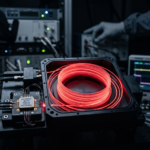
The diagnostic landscape of 2026 is defined by a singular, urgent mission: the elimination of time-to-diagnosis delays, particularly in cancer diagnostics, which often begins with cancer screening, detection, and identifying symptoms. For decades, the gold standard for cancer diagnostic confirmation has been the physical biopsy—a process that is inherently invasive, slow, and psychologically taxing for the patient. However, a seismic paradigm shift—including the adoption of liquid biopsy techniques—is underway.
We are witnessing the transition from “post-biopsy” analysis to “real-time optical” biopsy.
Cancer Diagnostics Revolution through Optical Coherence Tomography
This transition is anchored in the rapid growth of the Optical Coherence Tomography (OCT) market. In 2026, the OCT sector—now valued at over USD 3.04 billion—has matured beyond its traditional stronghold in ophthalmology, driving advances in diagnosis across various medical fields. Today, we are seeing OCT technologies revolutionize oncology, cardiology, and dermatology—particularly in cancer diagnosis and management—by providing cross-sectional, micron-scale imaging of biological tissue in real-time, which optimizes treatment outcomes.
This advancement in cancer diagnostic precision, precision medicine, and treatment is facilitated by the integration of advanced semiconductor photonics and the identification of key biomarkers.
The INPHENIX Advantage in Photonic Integration
At the core of this technological revolution is the light engine. Engineers are no longer satisfied with generic components; they require extreme spectral stability, customizable power output, and unprecedented bandwidth for any cancer diagnostic platform. This is where the INPHENIX advantage comes to the forefront.
By integrating custom gain chips, Semiconductor Optical Amplifiers (SOAs) as the critical signal boosters, and Superluminescent Diodes (SLDs) as the high-resolution light engines, designers are achieving the diagnostic precision required for sub-surface tumor margin detection.
High-Bandwidth Light Engines: The Foundation of 3D-OCT
The effectiveness of any cancer diagnostic system is fundamentally limited by its light source. In the quest for early detection, “good enough” is not an option.
Spectral Breadth and Resolution
Axial resolution is the cornerstone of OCT performance. To visualize early-stage pathological changes—such as micro-calcifications or cellular dysplasia—a bandwidth of 120nm or greater is the modern “gold standard.” This range is critical for imaging deeper tissue structures without suffering from scattering artifacts that plague narrower-spectrum systems, enhancing the overall efficacy of the cancer diagnostic imaging process.
The Physics of Precision with SLDs
Superluminescent Diodes (SLDs) are the ideal candidates for this role. Unlike traditional lasers, these SLDs offer a unique combination of high brightness and low coherence.
INPHENIX has pioneered architectures that provide the spectral smoothness required to achieve sub-micron axial resolution, allowing clinicians to distinguish between benign and malignant tissue boundaries with absolute clarity during a cancer diagnostic procedure.
Customization vs. Off-the-Shelf
No two tissues are the same, making cancer detection a complex challenge in medical imaging. Imaging the skin requires a different spectral window than imaging the retina or the GI tract. INPHENIX’s capability to provide custom spectral tailoring allows engineers to optimize the center wavelength and spectral shape, ensuring that the light engine is perfectly calibrated for its specific treatment and clinical application, ultimately improving the sensitivity of the cancer diagnostic device.
Semiconductor Optical Amplifiers (SOAs): Boosting the Signal
As diagnostic equipment moves from the lab to the patient’s bedside, the engineering focus has shifted to miniaturization, making technologies like liquid biopsy, which increasingly rely on cancer biomarkers, even more accessible for early diagnosis, screening, and accurate evaluation. However, shrinking the system creates a technical hurdle: signal loss.
The SNR Challenge
In compact, portable devices intended for a cancer diagnostic workflow, light must navigate through complex fiber architectures. Each junction introduces coupling losses that threaten the Signal-to-Noise Ratio (SNR). If the SNR drops, the image becomes “noisy,” leading to missed diagnoses.
Integration: Beyond the EDFA
For years, Erbium-Doped Fiber Amplifiers (EDFAs) were the standard, but they are bulky—making them incompatible with portable devices. INPHENIX has enabled a leap forward by championing the use of compact SOAs. These semiconductor-based amplifiers provide the necessary gain in a tiny footprint, enabling the development of handheld scanners that can reach deep into the body for a cancer diagnostic scan.
Thermal and Spectral Stability
In a clinical setting, an imaging system must remain stable. Whether in a surgery suite or a busy emergency department, the gain performance of an SOA must be consistent. INPHENIX’s SOAs are engineered for superior thermal and spectral stability, ensuring that image quality does not drift.
Convergence: Photonics, AI, and Diagnostic Accuracy
Hardware is no longer an isolated discipline. In 2026, the success of a cancer diagnostic system is measured by how well it “talks” to the AI diagnostic engine.
Feeding the AI Engine
Modern AI models are sophisticated, but they are fragile when it comes to input data quality, which may affect their ability to accurately detect symptoms. Consistent, low-noise photonic data from stable SLDs is mandatory to ensure the AI remains the clinician’s most reliable partner in a cancer diagnostic setting.
Real-Time Margin Detection
The ultimate goal of intraoperative OCT is to help surgeons perform a “clean” resection. By utilizing multi-wavelength approaches and INPHENIX’s high-precision gain chips, engineers can design systems in precision medicine that highlight tumor margins in real-time, drastically improving the success rate of a cancer diagnostic surgery.
Future Trends: The Lab-on-a-Chip
Looking toward 2027, the industry is moving toward Photonic Integrated Circuits (PICs) as part of advancing precision medicine, where early diagnosis plays a critical role in improving patient outcomes. The goal is a “Lab-on-a-Chip” architecture where the light source, the SOA, and the detector are all etched onto a single substrate. INPHENIX is laying the groundwork for this transition, providing the component design that will make these ultra-compact cancer diagnosis chips possible.
Technical Specifications & OEM Implementation
For the OEM manufacturer, the integration process must be streamlined.
The Integration Playbook
Successful implementation relies on modularity. Designers should aim for a “building block” approach, utilizing standardized fiber couplings and electronic control interfaces consistent with INPHENIX laser modules. This modularity allows for rapid prototyping, which is essential when iterating on new cancer diagnostics devices.
Compliance & Reliability
Medical-grade hardware is subject to strict regulatory oversight. Photonic components must not only perform well; they must be ruggedized against shock and thermal cycling. INPHENIX maintains a commitment to rigorous testing, ensuring that our SLDs and SOAs meet the safety protocols required for human-facing cancer diagnostic use.
Conclusion: Shaping the Future of Diagnostics
The 2026 cancer diagnostic landscape is not just about better hardware; it is about the power of integration and screening through precision medicine, which enhances both detection and identification of symptoms and treatment strategies. By co-designing photonic systems where the light engine is tailored to the AI’s needs and the patient’s anatomy, engineers and clinicians are building a world where cancer is detected earlier and treated more accurately.
The path forward requires a new level of collaboration. We invite you to explore the future of non-invasive diagnostics, especially in advancing cancer detection and in the fight against cancer.
Are you ready to integrate next-gen photonics into your clinical prototype? We invite you to explore the INPHENIX developer portal for detailed data sheets and whitepapers. Partner with us for custom design consultations, and let’s shape the future of medical diagnostics together. Visit INPHENIX.com to start the conversation today.