Industrial Engineering Analysis: Advanced Optical Sources for Autonomous Driving Systems
The rapid evolution of autonomous driving technology has placed unprecedented demands on automotive sensor suites, particularly Light Detection and Ranging (LiDAR) systems. As automakers strive for higher levels of autonomous capability—from SAE Level 2 advanced driver-assistance systems (ADAS) to fully autonomous Level 4 and Level 5 operations—the core optical emitter inside the LiDAR module, such as VCSELs, becomes a critical design choice.
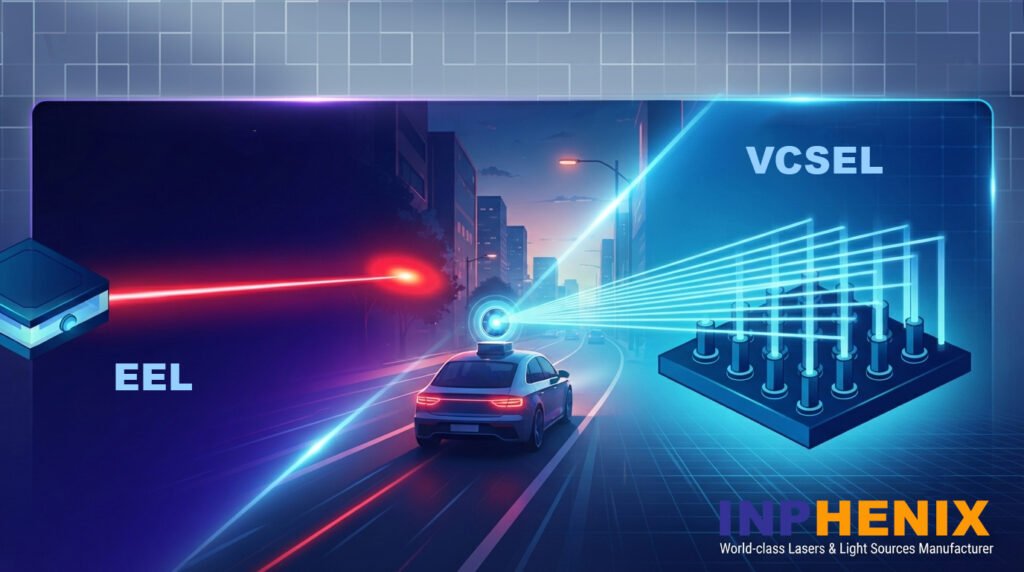
Among the various solid-state semiconductor technologies available today, the architectural debate consistently centers on two primary contenders: VCSEL (Vertical-Cavity Surface-Emitting Laser), laser diode, and EEL (Edge-Emitting Laser).
Selecting the optimal emitter requires a deep understanding of optical physics, thermal management, modulation techniques, manufacturing scalability, and system-level integration constraints.
Architectural Foundations: How VCSEL and EEL Emitters Operate
To understand why system architects choose one semiconductor design over the other, one must first examine their microscopic construction, 3d sensing capabilities, and light-emission mechanisms.
The Edge-Emitting Laser (EEL) Architecture
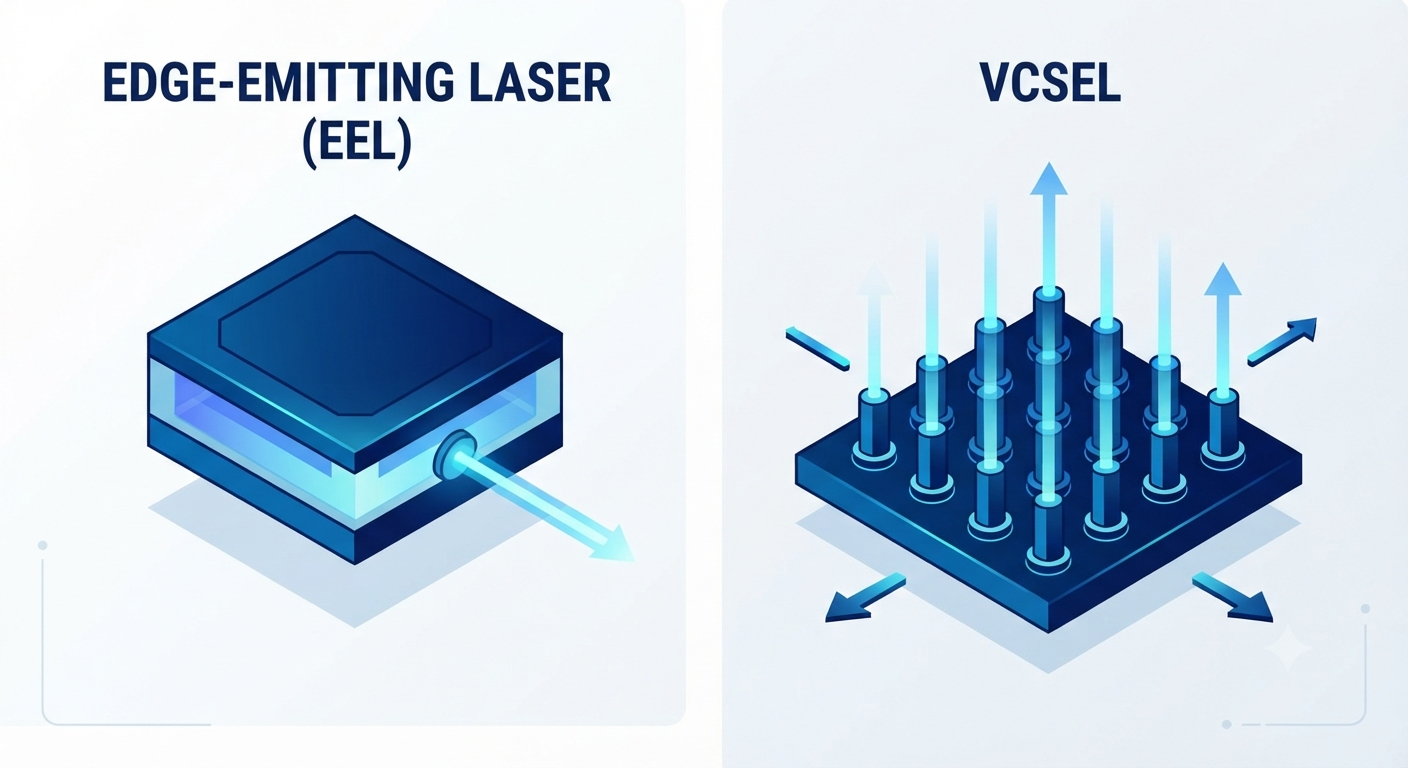
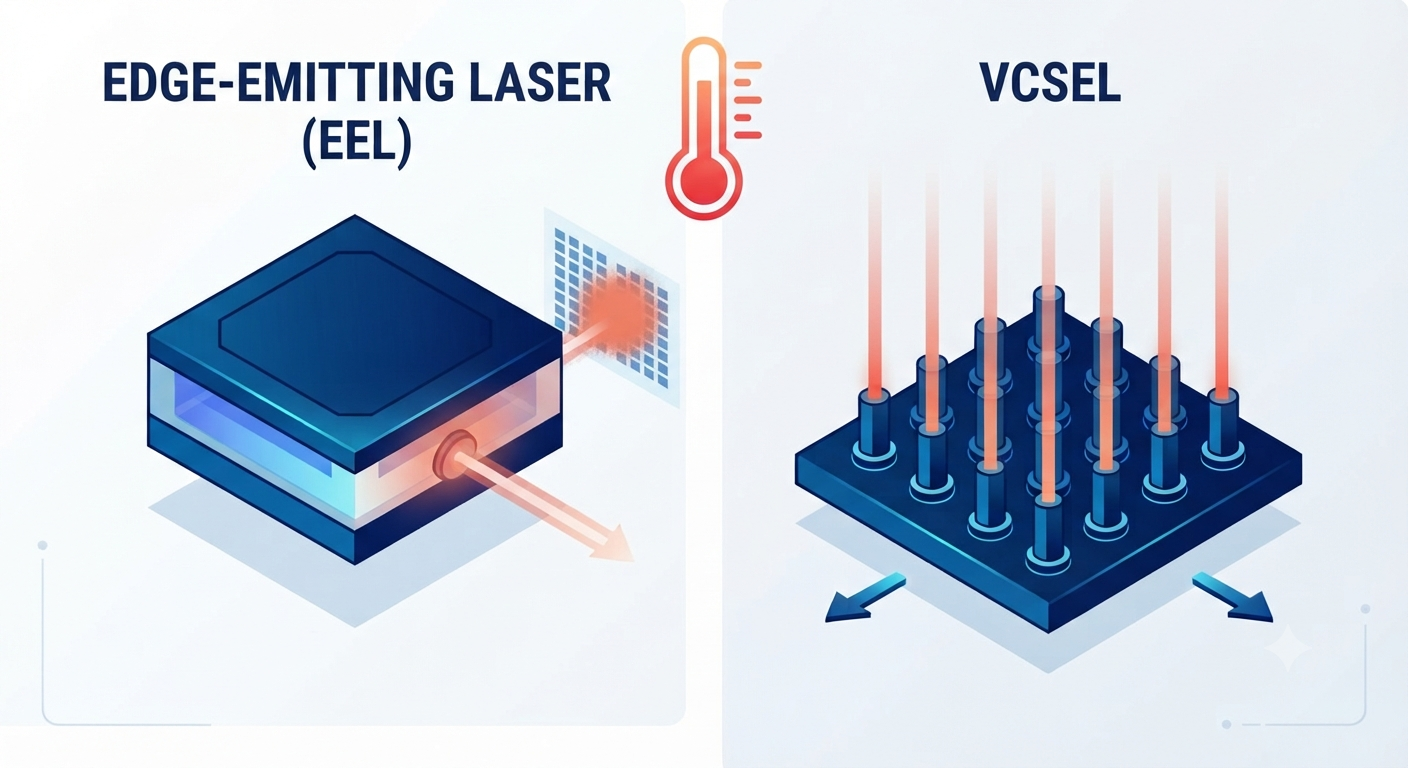
Edge-emitting lasers have been traditional workhorses of the photonics industry. In an EEL, the optical cavity is formed parallel to the semiconductor substrate surface. Light is generated within quantum wells and propagates horizontally through the crystal structure, eventually exiting from a cleaved facet on the edge of the chip.
Because the resonant cavity length is relatively long (typically hundreds of microns), EELs can store high optical gain and deliver substantial peak optical power per individual emitter. However, this horizontal emission mechanism introduces geometric limitations.
The emitting aperture is extremely narrow and asymmetric, resulting in an elliptical beam profile.
The VCSEL Paradigm
A VCSEL emits light perpendicular to the top surface of the semiconductor chip. The resonant cavity is vertically stacked between two Distributed Bragg Reflector (DBR) mirrors, sandwiching an active multiple-quantum-well region.
This surface-emitting geometry revolutionizes optical system design. Individual VCSEL emitters can be fabricated into massive, tightly packed two-dimensional arrays on a single semiconductor wafer. The circular emission aperture yields a symmetric, low-divergence beam profile that couples efficiently into optics.
Key Takeaway: While EELs rely on horizontal edge facets for high single-emitter power, advanced VCSEL technology leverages vertical 2D surface arrays for scalable, uniform illumination ideal for solid-state flash and scanning LiDAR architectures.
Core Performance Metrics in Automotive Environments
Automotive LiDAR systems operate under extreme environmental conditions. Emitters must endure wide temperature swings ranging from -40°C to over +105°C. Evaluating VCSEL versus EEL and laser diode performance reveals operational trade-offs.
Wavelength Stability and Thermal Drift
Wavelength stability is vital for LiDAR systems that utilize narrow bandpass filters. EEL devices exhibit a relatively high wavelength temperature coefficient (around .25 to .3 nm/°C). Advanced VCSEL designs offer superior thermal performance. Because the vertical cavity is exceptionally short, temperature coefficients for modern VCSEL arrays are lower, ensuring consistent spectral purity.
Beam Quality, Eye Safety, and Speckle Patterns
Eye safety is a non-negotiable regulatory requirement. EELs concentrate power into extremely small, high-intensity spots, complicating eye-safety compliance. Conversely, VCSEL arrays distribute optical power across multiple apertures, reducing peak radiance density. The multi-emitter nature of VCSEL configurations reduces coherent laser speckle, making vcsels an attractive option for advanced optical applications.
Scalability, Manufacturing Yields, and Cost Economics
The transition to mass-market deployment hinges on semiconductor manufacturing economics. An emitter technology must be scalable, cost-effective, and capable of rigorous quality control.
On-Wafer Testing vs. Facet Cleaving
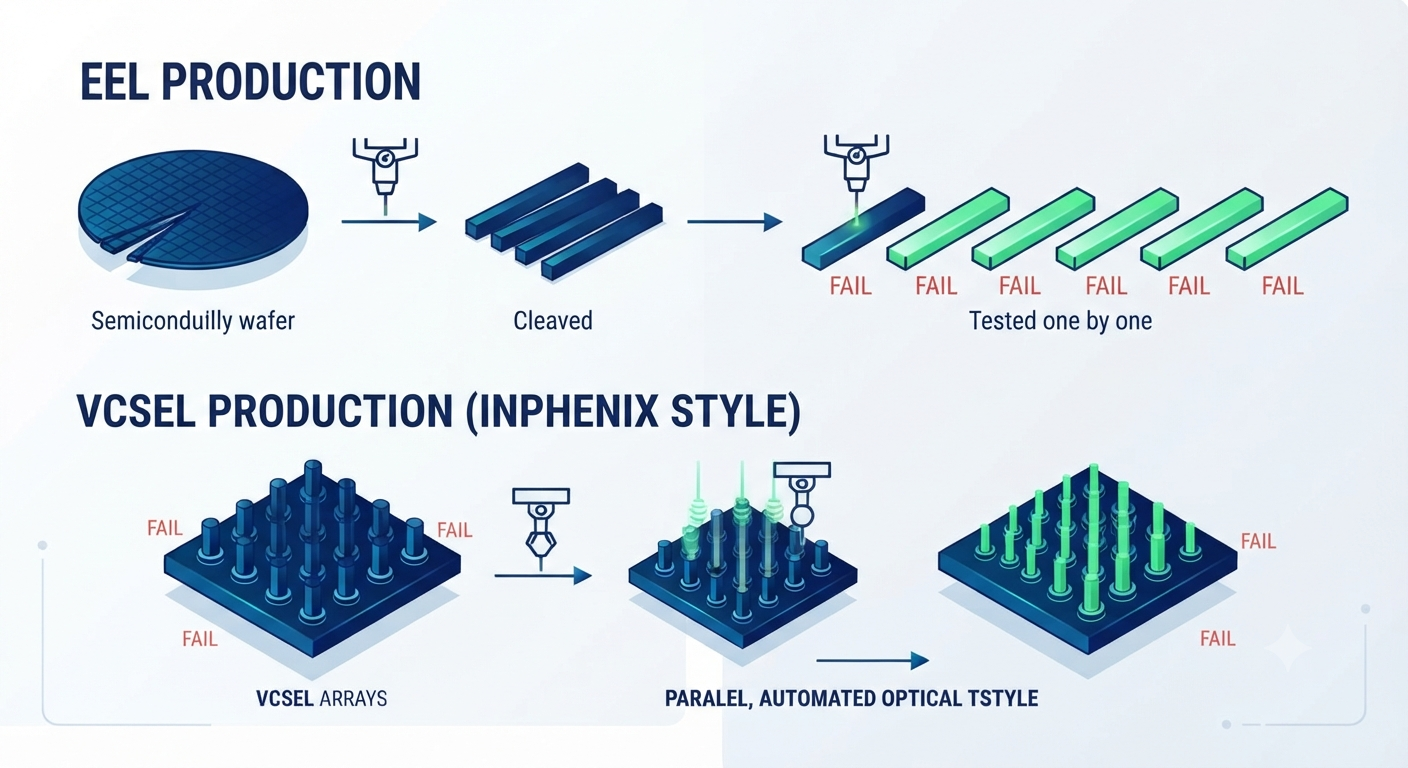
VCSEL technology allows on-wafer testability. EELs emit from the edge of chips, requiring dicing and cleaving before testing. In contrast, VCSEL devices can be fully tested on the wafer, driving up manufacturing yields and lowering costs.
| Performance & Economic Parameter | Edge-Emitting Laser (EEL) | VCSEL Technology |
|---|---|---|
| Emission Direction | Horizontal (Edge facet) | Vertical (Top surface) |
| Array Integration | Challenging (1D bars) | Native 2D arrays |
| Wafer-Level Testing | Not possible before dicing | Fully testable on-wafer |
| Beam Profile | Asymmetric, elliptical | Symmetric circular |
| Thermal Wavelength Drift | Moderate to High (~.3 nm/°C) | Low, stable |
Integration in Solid-State LiDAR Architectures
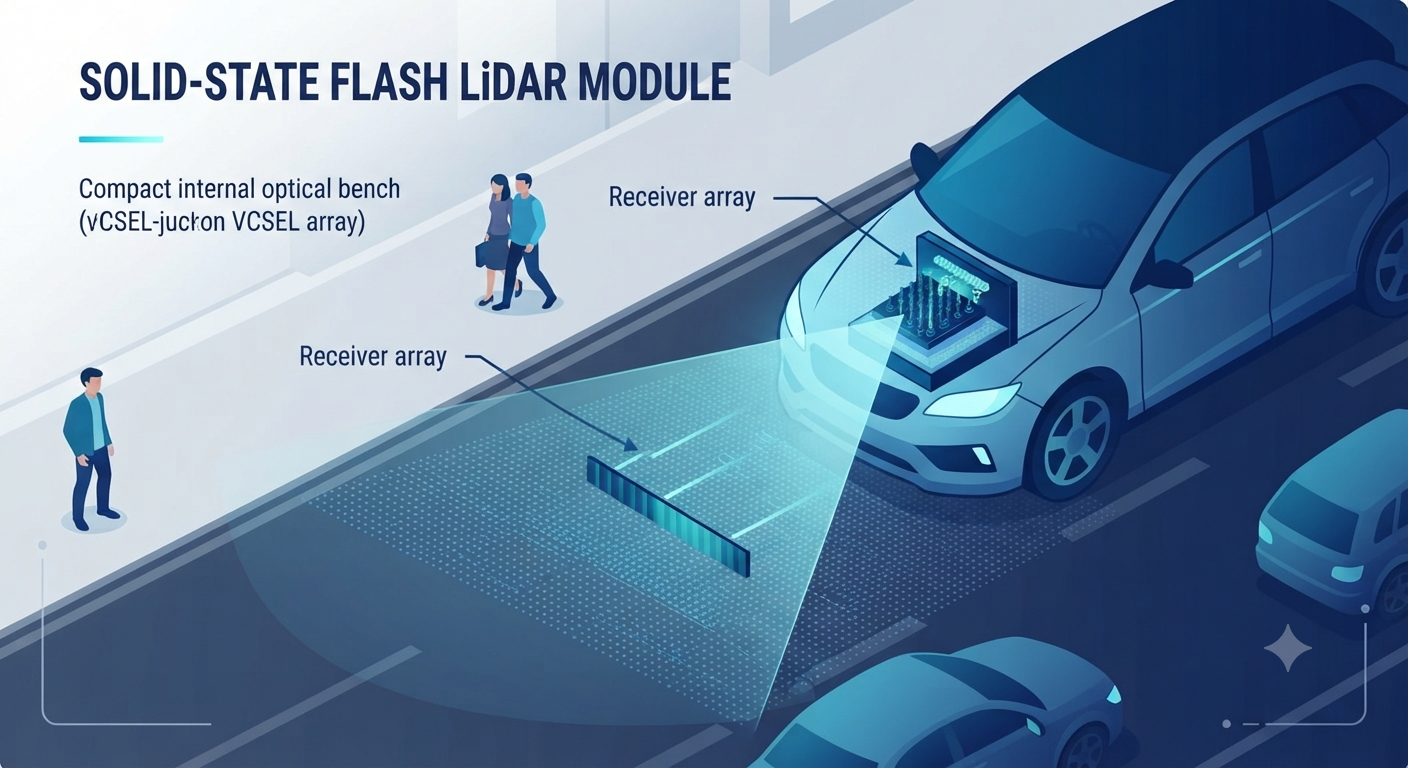
Automotive LiDAR design is shifting from mechanical assemblies to solid-state architectures, including Flash LiDAR and Optical Phased Array (OPA) systems.
Flash LiDAR Systems
Flash LiDAR requires a high-power, wide-area illumination source that emits massive peak power in nanosecond bursts. VCSEL arrays dominate this application domain by enabling compact, solid-state sensors with zero moving parts.
Scanning and Hybrid-Solid-State LiDAR
EELs have been favored for long-range detection due to high single-emitter power and effective modulation capabilities. However, advancements in high-power VCSEL stacking are closing this gap.

Future Outlook and Industry Adoption Trends
As the industry standardizes protocols for autonomous sensors, VCSEL technology offers unmatched scalability, superior thermal stability, circular beam symmetry, and cost effectiveness. VCSEL reliability now meets stringent automotive standards, providing system architects the exact specifications needed.
Conclusion
Choosing between VCSEL, laser diode, and EEL technology for automotive LiDAR is a systems-engineering decision defined by range requirements and cost. While edge emitters possess advantages in long-range detection, VCSEL technology offers significant benefits in scalability and cost through wafer-level testing. By harnessing these intrinsic benefits, automotive engineers can build safer, more reliable, and commercially viable LiDAR sensors that will power the future of autonomous mobility.
Unlock the Future of Automotive LiDAR with Inphenix VCSEL Technology
Ready to elevate your LiDAR systems with industry-leading VCSEL solutions? Discover how Inphenix’s advanced VCSEL technology can drive your innovation forward. Explore Inphenix VCSEL Solutions | Contact Our Experts
Partner with Inphenix today and accelerate your journey toward safer, smarter automotive sensing.